

Views: 0 Author: Site Editor Publish Time: 2026-10-11 Origin: Site


Choosing the wrong material grade carries high stakes for manufacturers. It often leads to premature mold degradation, dimensional inaccuracies, and increased production downtime. Relying on guesswork can quickly derail your manufacturing timelines. You need an objective, engineering-focused framework to evaluate silicone grades accurately. This means comparing physical properties, compliance requirements, and your actual production scale. We approach material selection with a skeptical, evidence-based mindset. You should avoid any "one-size-fits-all" promises. Choosing the right material is always a calculated trade-off. You must balance tear strength, viscosity, and cure times to meet your specific project constraints. In this guide, you will learn how to navigate these technical trade-offs effectively. We will break down exactly how to match your mold geometry to the correct silicone chemistry, ensuring you achieve optimal results for every production run.
Viscosity dictates detail: Low viscosity reduces bubble entrapment but may require specialized tooling for injection; high viscosity prevents flash but complicates degassing.
Durometer (Shore A) drives demolding: Lower hardness (10-20A) suits complex, fragile undercuts, while higher hardness (40A+) provides structural stability for flat, large-scale casts.
Chemistry determines longevity: Platinum-cured silicones offer superior dimensional stability and lifespan compared to tin-cured alternatives, though they demand strict contamination control.
Compliance is binary: Medical (USP Class VI/ISO 10993) and food-grade applications require certified base chemistries and audited cleanroom manufacturing environments.
We must evaluate material performance strictly through a production lens. Selecting liquid silicone rubber for mold making determines your tooling lifespan. It directly impacts the number of viable pulls before mold tear occurs. A mold failing after ten casts instead of one hundred drastically alters your unit economics. Frequent mold replacement eats into profit margins and stalls assembly lines. Detail degradation over time slows down output and forces engineers to constantly monitor quality.
Defect rates also stem directly from poor material choices. High shrinkage rates cause cast parts to drift out of acceptable tolerances. Improper degassing leads to trapped air within the cavity. Air bubbles form noticeable surface voids on your final cast parts. These defects increase scrap rates rapidly. You waste both time and expensive casting resins on ruined parts. Addressing these issues at the material selection phase prevents downstream failures.
The scale of production shifts your material requirements entirely. Low-volume prototype pouring relies heavily on Room Temperature Vulcanization (RTV). RTV accommodates manual mixing and open-air pouring processes. High-volume Liquid Injection Molding (LIM) demands entirely different physical traits. LIM requires rapid, heat-accelerated cure cycles. Automation increases your need for strict dimensional stability and precise flow rates. You must match the material grade precisely to your specific manufacturing volume.
Silicone chemistry dictates physical performance and library longevity. You must choose between two primary curing mechanisms. Each offers distinct advantages and presents unique operational risks. Understanding these chemical differences is critical for engineering success.
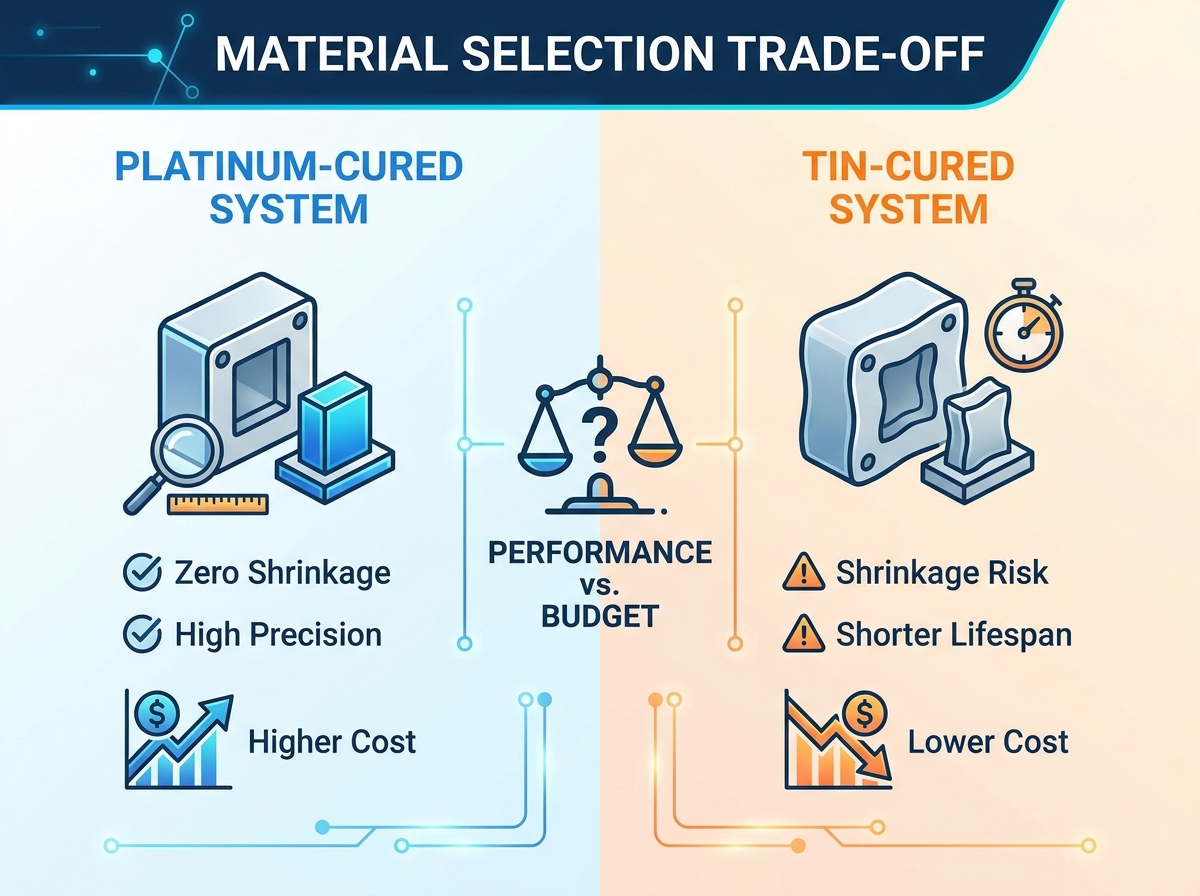
Platinum-cured silicones utilize an addition-cure mechanism driven by a platinum complex catalyst. They do not release any chemical byproducts during vulcanization. This stable chemistry guarantees zero shrinkage upon curing. It provides exceptionally long mold library life. These silicones retain their physical properties over decades without turning brittle. They represent the undisputed standard for a precision mold making silicone. Their high cross-linking density delivers superior tear strength.
However, platinum systems are highly susceptible to cure inhibition. Certain chemicals poison the platinum catalyst on contact. Exposure to sulfur, latex gloves, amine-based epoxies, or certain 3D printing resins will prevent curing. The silicone simply remains sticky or entirely liquid at the interface. You must enforce strict contamination control protocols in your workshop to use these grades successfully.
Tin-cured silicones utilize a condensation-cure mechanism. They rely on a tin salt catalyst and ambient moisture to cure. They release alcohol as a byproduct during vulcanization. This chemistry is cheaper and highly resistant to cure inhibition. You can safely pour it directly over sulfur-based modeling clays. It serves exceptionally well for rapid prototyping and less demanding industrial substrates.
The primary drawback is dimensional instability. The continuous evaporation of alcohol byproducts causes gradual shrinkage over time. You can expect a 1% to 2% dimensional shift within a few months. Tin-cured molds also suffer from a shorter library lifespan. Natural polymer degradation makes the rubber brittle after two to five years.
Base Chemistry Comparison Guide
Performance Metric | Platinum-Cured (Addition) | Tin-Cured (Condensation) |
|---|---|---|
Shrinkage Rate | Virtually Zero (<0.1%) | 1% to 2% over time |
Cure Inhibition Risk | High (Sulfur, Latex, Amines) | Low (Highly robust) |
Library Lifespan | 20+ Years | 2 to 5 Years |
Cost Profile | Premium | Economical |
You must align specific physical properties with your master geometry. Theoretical data sheet numbers only matter when applied to actual workshop physics. We evaluate three primary metrics for successful mold making.
Viscosity measures internal flow resistance in centipoise (cps). It affects how effectively the material flows into micro-cavities. To visualize this, water is 1 cps, while honey is around 10,000 cps. Selecting the correct silicone rubber viscosity for molds dictates your bubble management strategy. Low viscosity (under 10,000 cps) pours like syrup. It readily self-degasses and captures extreme microscopic detail. High viscosity (over 40,000 cps) behaves like grease or putty. It prevents flash but complicates the degassing process significantly.
You must balance self-degassing capabilities against structural integrity. Low-viscosity grades often lack the sheer physical strength required for high-pressure injection casting. They might deform under heavy clamping pressure.
Durometer measures the cured rubber's resistance to surface indentation. We use the Shore A scale for flexible molds. You must match the Shore A hardness to the master model’s complexity. A soft 10A to 20A rubber feels like a flexible rubber band. It stretches easily around severe undercuts without damaging the master or the final cast. Conversely, flat and large-scale casts require robust structural stability. A firmer 40A+ rubber resembles a shoe heel. It prevents the mold walls from bowing outwards during heavy resin pours.
Tear strength measures the material's resistance to notch propagation. Deep undercuts place immense mechanical stress on mold edges during demolding. High tear strength is critical to prevent these thin edges from snapping off over repeated cycles. Manufacturers typically test this using Die B or Die C tearing methods.
Elongation at break indicates how far the rubber stretches before failing. A 500% elongation means it stretches five times its original length. However, we consistently observe an inverse relationship in polymer networks. High elongation often sacrifices structural rigidity. You must balance extreme stretchability with the need to maintain accurate, rigid cavity dimensions.
Regulated industries mandate specific material certifications. Compliance in these sectors is strictly binary. You either meet the standard, or you face severe penalties and product recalls.
Medical applications require stringent, documented biocompatibility testing. Formulations must pass rigorous tests for cytotoxicity, sensitization, and skin irritation. Manufacturers demand absolute lot-to-lot traceability for quality assurance audits. The cured rubber must also withstand harsh sterilization cycles without degrading. You must verify its long-term resistance to autoclave heat, gamma radiation, and Ethylene Oxide (EtO) gas exposure.
Food-grade applications require highly pure base chemistries. The FDA mandates strict limits on extractable compounds. Manufacturers must follow specific outgassing procedures before use. Post-curing the mold in an industrial oven for several hours is usually necessary. This critical step drives off any remaining volatile organic compounds (VOCs). It ensures the mold remains entirely safe for casting chocolates, fondants, or commercial ice.
Industrial molds face extreme thermal shocks daily. Casting low-melt metals like pewter or zinc subjects the mold cavity to intense, localized heat. High-exothermic casting epoxies also generate significant thermal stress during their curing phase. You must evaluate thermal stability thresholds carefully. Standard silicones degrade quickly above 200°C. High-heat formulations incorporate specialized iron oxide additives to survive these brutal thermal cycles repeatedly.
Theoretical properties mean nothing if workshop realities cause continuous failures. You must manage common production risks proactively to ensure consistent yields.
Contaminants ruin platinum-cured molds instantly. We identify amines, sulfur, masking tapes, and certain adhesives as common workshop contaminants. Freshly printed SLA 3D prints also cause severe inhibition due to unreacted UV monomers. You must implement strict isolation protocols. Sealing the master model with a reliable barrier, such as an acrylic clear coat or Polyvinyl Alcohol (PVA) release agent, is essential. Always test a small, hidden surface area before committing to a full mold pour.
Your current workshop equipment dictates your material options. Assess whether your vacuum degassing chambers can handle high viscosities. Thick mixtures expand significantly under vacuum and will boil over if the chamber lacks sufficient headroom.
Mixing ratios also present tangible equipment challenges. A 1:1 mix ratio by volume is simple and forgiving for manual pouring. A 10:1 mix ratio by weight requires precision digital scales and rigorous mixing. Automated injection molding pumps must specifically match the viscosity and mix ratio of your chosen grade to prevent cavitation.
Pot life dictates your active working window. Complex pours require a long pot life. You need ample time to mix components thoroughly, vacuum degas the mixture, and pour it carefully into the mold box. However, a long pot life universally results in a long demold time. Balancing this working time against your required production cycle time is critical for maintaining profitability. Slow curing phases inevitably bottleneck your daily output.
Use this systematic engineering approach to narrow down your material options. It removes guesswork from the selection process and prevents costly purchasing mistakes.
Step 1: Define the Non-Negotiables. Isolate any required certifications immediately. Filter out non-compliant grades if you need medical, food-grade, or aerospace approvals. Determine your maximum budget per pound or kilo. This establishes your absolute baseline constraints.
Step 2: Assess the Master Geometry. Analyze the most aggressive undercut on your master model. Determine the required Shore A hardness and elongation based on this specific geometry. Choose a softer rubber (10A-20A) for delicate, deep undercuts. Select a firmer rubber (40A+) for large, flat surfaces requiring high dimensional accuracy.
Step 3: Audit the Production Environment. Evaluate your workshop for potential contamination risks. Choose a Tin-cured silicone if you cannot entirely avoid sulfur clays or unwashed SLA prints. Choose a Platinum-cured silicone if you maintain a highly controlled environment and require long-term dimensional precision. Confirm you have the necessary degassing equipment for the selected viscosity.
Step 4: Request Technical Data Sheets (TDS). Never rely purely on promotional marketing claims. Request the official TDS from the manufacturer. Verify actual tear strength, viscosity, and shrinkage data independently. Cross-reference these standardized numbers against your project requirements. Always order small sample kits to run physical tests before buying bulk drums.
Selecting the right material requires balancing physical properties with production realities and compliance needs. You must weigh viscosity limits against your degassing equipment. You must balance Shore A hardness against the required tear strength for undercuts. Do not rush this evaluation process, as poor choices cascade into expensive production delays.
We highly recommend starting with a small-batch material trial. Run an A/B test using two distinct viscosities or hardness levels. Evaluate exactly how they perform during the demolding phase. Test them repeatedly against your specific casting resins to observe wear patterns. Consult directly with a material engineer if you face complex geometries or extreme thermal requirements. Always request detailed TDS and MSDS documentation for your shortlisted materials before committing to a full production run.
A: The sweet spot for complex undercuts lies between 15A and 30A. This range offers enough flexibility to stretch over aggressive overhangs without snapping. If your master model is extremely fragile, lean closer to 10A or 15A. Harder grades above 30A lack stretch and will likely break delicate parts during the demolding process.
A: You can add reactive silicone thinners to lower viscosity. Thinners improve flow and actively assist with bubble release. However, adding too much thinner drastically reduces tear strength and induces oil bleed over time. Never exceed the manufacturer's recommended ratio, which is typically capped at 10% by total weight.
A: Platinum cure inhibition is the most common culprit. The platinum catalyst reacts negatively to specific surface contaminants. Common offenders include sulfur-based modeling clays, latex gloves, amine epoxies, and unwashed UV 3D printing resins. The silicone will remain sticky and useless. Always seal suspect masters and run a small patch test.
A: Lifespan depends entirely on the casting material and chemistry. Smooth polyurethane resins might yield hundreds of perfect casts. Abrasive materials like concrete or highly exothermic epoxies degrade the mold surface rapidly, often limiting you to 30 or 50 casts. Proper application of mold release agents significantly extends this operational lifespan.


