

Views: 0 Author: Site Editor Publish Time: 2026-10-08 Origin: Site


High Consistency Rubber (HCR) extrusion relies on a delicate balance of compound formulation, die design, and thermal control. When this balance fails, scrap rates rise rapidly. Yield drops, and compliance in heavily regulated sectors like medical or aerospace is jeopardized. Pinpointing the root cause of an extrusion defect requires distinguishing between mechanical processing errors and fundamental material flaws. You cannot simply tweak machine settings to fix a poor chemical formulation.
Our objective is to provide engineers and procurement teams an evidence-based framework. We will help you diagnose common HCR silicone extrusion defects systematically. You will learn how to determine whether to adjust process parameters or upgrade materials entirely. We will also establish clear criteria for evaluating new silicone compound suppliers, ensuring your next production run achieves optimal yield.
Visual defect diagnosis is the first step: Porosity, surface roughness, and scorch each point to distinct thermal, mechanical, or chemical imbalances.
Process vs. Material: Many persistent defects cannot be engineered out on the line and require a re-evaluation of the base silicone rubber extrusion compound.
Filler selection matters: Upgrading to fumed silicone rubber for extrusion often resolves stubborn surface finish and dimensional stability issues.
Supplier vetting mitigates risk: Resolving defects long-term requires partnering with compounders who guarantee lot-to-lot consistency and offer transparent formulation data.
Extrusion defects do more than create immediate scrap. They disrupt the entire manufacturing schedule. High scrap rates and frequent line stoppages directly erode profit margins. This margin erosion accelerates rapidly when you are extruding complex profiles or tight-tolerance tubing. Engineers often spend hours troubleshooting the line, pulling valuable resources away from other projects. Unpredictable yields make inventory forecasting nearly impossible. Manufacturers must produce surplus material just to guarantee order fulfillment. This inefficiency cascades through the supply chain.
In highly regulated industries, defects introduce severe compliance risks. Medical applications must adhere strictly to ISO 10993 standards. Food-grade applications fall under intense FDA scrutiny. Internal porosity or surface imperfections pose immediate threats in these sectors. Microscopic voids can harbor bacteria. Surface roughness compromises structural integrity under pressure. A single non-compliant batch often leads to costly rejections, mandatory recalls, and damaged brand reputation.
Establishing clear success criteria is vital for any resolution strategy. A successful intervention must achieve three main goals:
Lower scrap rates significantly below your historical baseline.
Maintain or increase continuous extrusion speeds.
Ensure lot-to-lot mechanical consistency without requiring constant operator intervention.
Achieving these goals transforms your extrusion line from a bottleneck into a reliable production asset. It eliminates the guesswork and stabilizes output quality.
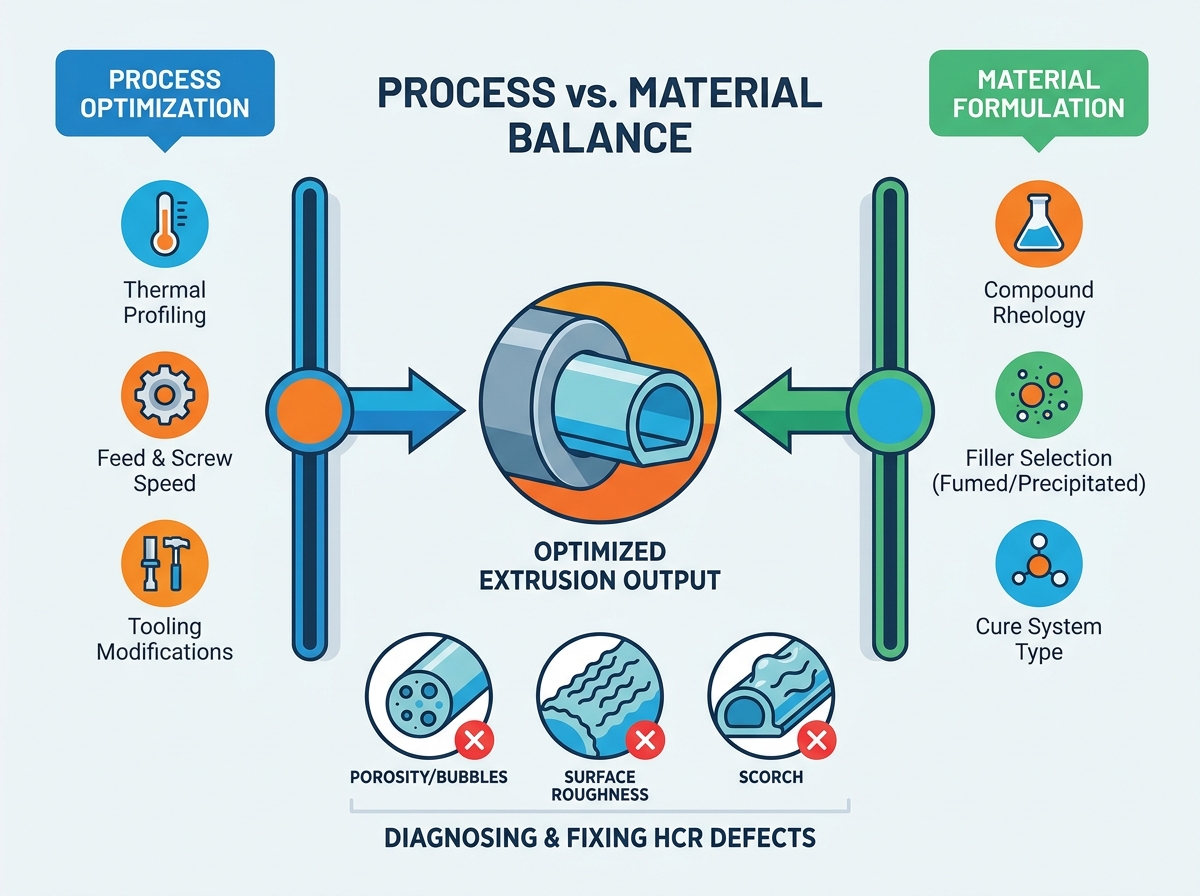
Accurate diagnosis starts at the die exit. Operators must identify visual symptoms immediately to prevent producing thousands of feet of bad product. Understanding the exact nature of the defect points directly to its root cause.
Porosity is one of the most stubborn issues in rubber manufacturing. Symptoms include distinct voids within the profile wall or visible blisters on the exterior surface. These pockets of gas weaken the material significantly.
Root causes usually stem from air or moisture. Entrapped air during the initial milling process often carries through the extruder. Excessive moisture in the compound also causes blistering as it turns to steam during curing. In peroxide-cured systems, premature release of volatile byproducts before full crosslinking is a primary culprit. The gas expands inside the rubber before the material develops enough structural integrity to resist it. A common mistake here is increasing oven temperatures to cure the rubber faster. This actually exacerbates the problem by flashing the volatiles too aggressively.
A high-quality extrusion should feature a smooth, glossy exterior. When surface roughness occurs, the product takes on a matte, scaly, or ridged finish. Engineers often refer to this as "sharkskin" or melt fracture.
Root causes typically relate to shear stress. Excessive extrusion speed exceeding the compound's critical shear rate rips the surface as it exits the die. Incorrect die temperature also plays a major role. If the die is too cold, the rubber drags along the metal. Furthermore, poor dispersion of fillers within the silicone matrix creates microscopic lumps. These lumps tear the surface layer during extrusion. Best practices dictate checking filler dispersion quality before adjusting die temperatures.
Tight tolerances define high-value extrusions. Dimensional instability presents as a profile expanding unpredictably upon exiting the die. It fails to meet dimensional tolerances, sagging or warping before entering the curing oven.
Root causes point toward material strength and heat management. Insufficient "green strength" of the uncured rubber causes immediate collapse or swell. Excessive localized heat in the extruder barrel reduces compound viscosity prematurely. Improper tooling design, specifically die land length, fails to control the rubber's memory effect. The material tries to snap back to its pre-extrusion shape.
Scorch ruins the cosmetic and functional properties of the rubber. Symptoms include hard lumps, grainy particles, or visible flow lines appearing in the extrudate. These cured particles disrupt the surrounding uncured flow.
Root causes are almost always thermal or chemical. Extruder barrel temperatures set too high trigger early crosslinking. Excessive friction inside the barrel generates hidden shear heating. Alternatively, an overly aggressive catalyst package in the compound might activate at lower-than-expected temperatures. Operating with dead zones in the extruder head also allows material to stagnate and scorch.
Deciding between tweaking machine settings and changing the compound is a critical engineering junction. Wasting days on process optimization for a fundamentally flawed material burns through cash.
Before discarding a batch of material, you must eliminate mechanical variables. Process adjustments focus on thermal and kinetic energy management.
First, execute thorough thermal profiling. Calibrate the barrel, head, and die temperatures precisely. You must prevent premature cross-linking while maintaining adequate flow. Create a temperature gradient. Keep the feed zone cool and gradually increase heat toward the die.
Next, optimize your feed and screw speed. Balancing RPM manages internal shear heat and dictates output volume. Running the screw too fast generates massive friction. This friction acts as an invisible heater inside the barrel. Slowing down often improves quality, though it sacrifices throughput.
Finally, consider tooling modifications. Adjusting die lands compensates for predictable die swell. Lengthening the land area gives the rubber more time to relax its internal stresses before exiting into the open air. This simple tooling change often stabilizes dimensions.
Process fixes have hard limits. If adjusting temperatures and speeds drastically reduces output yield, you have a material problem. If you slow the line down to fix sharkskin but miss your production targets, the process fix is unsustainable. The issue likely lies deep in the compound's rheology.
Moving from a generic material to a specialized silicone rubber extrusion compound provides a permanent solution. You might need to move away from in-house compounding. Partnering with a specialized toll compounder offers better consistency. Alternatively, altering the base formulation yields better results. Switching catalyst types or adjusting filler loading changes how the rubber behaves under stress. A better compound requires less operator intervention and forgives minor machine fluctuations.
Assessing filler types is a primary evaluation dimension for resolving mechanical defects. The silica filler gives HCR silicone its physical strength. The manufacturing method of this silica changes everything.
Compounds utilizing precipitated silica are highly cost-effective. They serve well in general-purpose applications. However, they carry distinct limitations. Precipitated silica acts like a microscopic sponge. It absorbs ambient moisture easily during storage. This trapped moisture turns to steam during curing, leading directly to porosity.
Furthermore, precipitated bases often exhibit lower green strength. The uncured rubber feels softer and more prone to deformation. Holding tight tolerances on complex, thin-walled profiles becomes incredibly difficult. The material sags under its own weight before crosslinking completes.
Upgrading to a premium filler dramatically alters extrusion dynamics. The benefits impact every stage of the production line.
Superior Green Strength: Highly suited for intricate geometries or thin-walled tubing. It significantly reduces die swell and prevents sagging before curing. The profile holds its shape perfectly in mid-air.
Surface Finish: Yields a smoother, higher-clarity finish. The refined particle structure drastically reduces "sharkskin" effects, even at higher extrusion speeds.
Moisture Resistance: Fumed silica has a lower inherent moisture content. It resists absorbing humidity from the factory floor. This minimizes boiling and porosity during high-temperature vulcanization (HAV).
If you face persistent quality issues, switching to fumed silicone rubber for extrusion is highly recommended. It acts as a mechanical upgrade hidden inside a chemical change.
Feature / Characteristic | Precipitated Silica Base | Fumed Silica Base |
|---|---|---|
Moisture Absorption | High (prone to ambient humidity) | Low (highly resistant) |
Green Strength | Moderate to Low | Excellent (ideal for complex shapes) |
Surface Finish Quality | Standard (matte to semi-gloss) | Premium (smooth, high-clarity) |
Porosity Risk | Higher (due to moisture flashing) | Minimal |
Upfront Material Cost | Lower | Higher |
The cost-to-outcome ratio strongly favors fumed bases in high-stakes applications. The higher upfront cost of fumed bases is frequently offset. You recover the expense through reduced scrap rates, faster line speeds, and fewer rejected lots.
Changing a silicone formulation introduces new variables. You must manage these transition risks carefully to avoid compounding your problems.
Transitioning requires re-qualifying the material against your regulatory standards. You will likely need to adjust die tooling. Fumed materials swell differently than precipitated ones. You must also recalibrate oven temperatures for HAV or IR curing systems. The new material will absorb heat at a different rate.
Risk mitigation demands a structured approach. Never switch an entire production line over night. Conduct controlled pilot runs first. Request comprehensive rheology data from the supplier before line trials begin. Specifically, ask for Moving Die Rheometer (MDR) curves. These curves show exactly how and when the rubber cures. Additionally, demand plasticity measurements, such as Williams Plasticity data. This confirms the material's viscosity matches your extruder's capabilities.
Not all silicone suppliers deliver equal quality. Vet your partners rigorously using these specific criteria:
Batch Consistency: Require statistical process control (SPC) data. The supplier must prove lot-to-lot uniformity over time. Variations in incoming raw materials ruin optimized extrusion processes.
Customization Capabilities: Look for the ability to tweak durometer, cure systems (platinum vs. peroxide), and colorants. They must do this without degrading the base physical properties.
Regulatory Alignment: Demand verified certifications. Depending on your industry, this means ISO 10993, FDA compliance, or USP Class VI. Verify their cleanroom compounding capabilities if your product requires strict contamination control.
Resolving HCR extrusion defects requires moving beyond temporary line adjustments. You must address the underlying material limitations holding your process back. Tweak the machine settings first, but recognize when a compound is fundamentally incapable of meeting your tolerances.
To eliminate these defects permanently, take the following action steps:
Document your current defect rates and categorize them by visual symptom.
Establish a firm baseline for your existing process parameters, including thermal profiles and line speeds.
Eliminate mechanical variables by optimizing die lands and feed rates.
Consult with a specialized silicone compounder to trial a fumed formulation optimized for your specific tooling and end-use requirements.
A: Porosity typically occurs when volatile decomposition products from the peroxide fail to escape before the rubber surface skins over. It also happens due to trapped air or excessive moisture in the feed stock turning to steam during the curing process.
A: Platinum addition-cured systems produce no volatile byproducts. This virtually eliminates chemical-induced porosity and odor. However, they require stricter handling environments to avoid catalyst poisoning from heavy metals or sulfur compounds.
A: Modifying the die land length can optimize flow and reduce shear stress at the exit. This may mitigate minor surface roughness. However, severe melt fracture usually necessitates a compound adjustment or lower extrusion speeds to keep shear rates manageable.
A: Shelf life depends heavily on the cure system. Peroxide compounds generally last longer, often 3 to 6 months. Catalyzed platinum systems may experience "crepe hardening" or premature crosslinking within days or weeks if not stored cold. Always verify the manufacturer's spec sheet.


