

Views: 0 Author: Site Editor Publish Time: 2026-08-10 Origin: Site


High-voltage substation and transmission network reliability hinges on insulator integrity. Unexpected flashovers lead to catastrophic downtime, while mechanical failures trigger severe financial penalties for grid operators. The industry is rapidly transitioning from traditional porcelain to polymer composites. This shift solves heavy weight and seismic vulnerability issues inherent in ceramic materials. However, the market is flooded with varying qualities of silicone compounds. Specifying the wrong formulation leads to premature tracking, rapid erosion, and moisture ingress into the fiberglass core. To mitigate risk, engineers and procurement teams must evaluate silicone rubber formulations strictly based on verifiable material properties and manufacturing methods. Compliance with stringent international testing standards is non-negotiable. This rigorous approach ensures decades of reliable service in harsh environments, protecting critical infrastructure from preventable outages.
Hydrophobicity is Dynamic: The ability of the silicone to not only repel water but transfer hydrophobic properties to pollution layers via Low Molecular Weight (LMW) siloxanes is the primary defense against leakage currents.
Filler Ratios Dictate Lifespan: The inclusion and precise distribution of Alumina Trihydrate (ATH) fillers are non-negotiable for achieving the arc track and erosion resistance required in high-voltage environments.
Manufacturing Method Matters: The choice between High Temperature Vulcanized (HTV) silicone and Liquid Silicone Rubber (LSR) directly impacts the insulator's mechanical bonding, filler capacity, and long-term environmental stability.
Testing Validates Claims: Procurement decisions must be backed by rigorous third-party testing against IEC and IEEE standards, distinguishing between original design tests for material qualification and routine factory tests.
Substations require massive structural support combined with absolute electrical isolation. Air-insulated substations (AIS) rely on post insulators to isolate live components from the ground structure. We see these units supporting heavy aluminum busbars, massive disconnect switches, and rigid transformer connections across 115kV, 230kV, and 500kV networks. The mechanical demands are extreme. A post insulator must withstand high cantilever bending moments during short-circuit events. Wind and ice loading add continuous stress to the structure. Historically, utilities used porcelain for these applications. Porcelain is heavy, brittle, and performs poorly during seismic events. Earthquakes shatter ceramic insulators, causing massive grid failures and dangerous safety hazards. Polymer composites solve this structural problem. They offer a high strength-to-weight ratio. They flex during seismic activity instead of snapping. However, the polymer housing must provide flawless electrical isolation. It cannot degrade under UV light or high electrical stress.
A composite post insulator consists of three main structural parts. The core provides the mechanical strength. Manufacturers use Fiberglass Reinforced Plastic (FRP) for this core. Specifically, boron-free ECR-glass prevents brittle fracture from acid attacks caused by electrical discharges. Metal end-fittings transfer the mechanical load to the mounting structure. Manufacturers crimp these galvanized steel or aluminum fittings directly onto the FRP core using acoustic emission monitoring to prevent fiber damage. The housing protects the core. We use silicone rubber to shield the fiberglass from moisture, pollution, and UV radiation. The interface between the silicone and the FRP core is the most vulnerable point in the entire assembly. If the chemical bond fails, moisture wicks into the fiberglass. High voltage stress then causes internal tracking. The core carbonizes from the inside out. The insulator eventually snaps under normal mechanical loads.
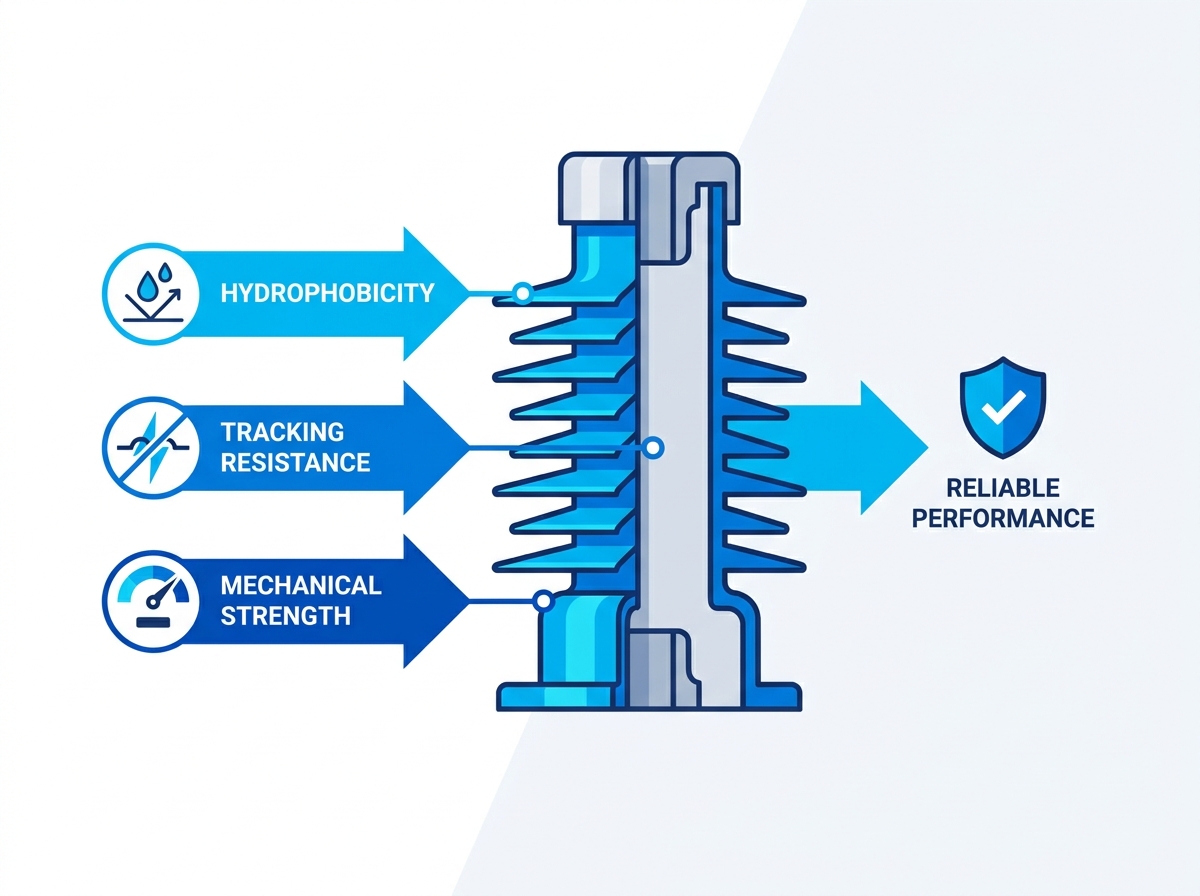
Surface insulation depends entirely on water behavior. We measure this using the contact angle. A high contact angle means water droplets bead up and stand tall on the surface. They do not flatten. If water flattens, it forms a continuous conductive film across the insulator. Leakage currents flow through this film. This current heats the surface, evaporating the water and causing dry-band arcing. High contact angles prevent the continuous film from forming. Silicone rubber offers a unique advantage called hydrophobicity transfer. The material contains Low Molecular Weight (LMW) siloxanes. These mobile molecules migrate from the bulk rubber to the surface continuously. When dirt, salt, or industrial pollution coats the insulator, the LMW siloxanes encapsulate the contaminants. The pollution layer itself becomes hydrophobic. We must evaluate recovery metrics when selecting materials. Heavy rain, corona discharge, or severe arcing temporarily destroy surface hydrophobicity. The silicone must recover its hydrophobic state quickly. High-quality formulations recover in hours, while poor formulations take days or never recover.
The primary job of the housing is electrical isolation under extreme stress. We look at baseline electrical metrics to verify performance. Volume resistivity must exceed 10^14 ohm-cm to stop current flow through the bulk material. Dielectric breakdown voltage measures how much electrical stress the rubber can take before puncturing. Post insulators face continuous high-voltage stress, and the silicone must not puncture under any operational condition. Thermal stability is equally critical for long-term survival. Substations operate in extreme environments. Winter temperatures in northern regions drop below -40°C. Desert installations exceed +50°C ambient, with surface temperatures much higher due to solar radiation. The silicone must maintain dielectric integrity across this entire range. It cannot become brittle and crack in the cold. It cannot melt, soften, or lose mechanical strength in the heat.
Dry-band arcing is inevitable in severe pollution environments. When arcing occurs, the surface temperature spikes instantly. We use Alumina Trihydrate (ATH) fillers to protect the rubber from burning. ATH suppresses dry-band arcing through a specific chemical reaction. When the arc heats the ATH to roughly 220°C, it undergoes an endothermic reaction. It releases water vapor directly into the electrical arc. This instantly cools the plasma. It also leaves behind a non-conductive aluminum oxide residue on the surface. This residue shields the underlying polymer and prevents carbon tracking. Formulating the rubber requires balancing these properties. High ATH filler content maximizes erosion resistance. However, adding too much ATH makes the uncured rubber highly viscous. It reduces the mechanical flexibility of the cured housing and complicates the molding process. Specifying the right high voltage post insulator silicone rubber requires balancing filler ratios with mechanical needs.
Silicone Formulation Type | ATH Filler Content | Arc Tracking Resistance | Mechanical Flexibility | Manufacturing Complexity |
|---|---|---|---|---|
Standard HTV Silicone | Low to Medium (20-30%) | Moderate | High | Low |
High-ATH HTV Silicone | High (40-50%) | Excellent | Moderate | High (Requires heavy mixing) |
Standard LSR Silicone | Low (Under 15%) | Moderate | Excellent | Low (Injection molded) |
Advanced High-ATH LSR | Medium to High (30%+) | Very Good | Good | Very High (Viscosity limits) |
The chemical structure of silicone provides inherent weathering resistance. The siloxane backbone consists of alternating silicon and oxygen atoms. The bond energy of this backbone is significantly higher than the carbon-carbon bonds found in EPDM or other organic polymers. This high bond energy means UV radiation from the sun cannot easily break the polymer chains. The material resists ozone degradation caused by continuous corona discharge. It withstands salt spray in coastal environments without degrading. It ignores corrosive industrial chemicals found near refineries or mining operations. We must evaluate aging characteristics during procurement. Poor formulations suffer from surface chalking. They craze and harden over time, losing their ability to transfer hydrophobicity. A properly formulated silicone housing ensures a 30-year expected lifespan without significant material degradation.
The housing must bond perfectly to the FRP core. We require a flawless, void-free chemical connection. Manufacturers apply a specialized primer to the core before molding the silicone. The silicone must fuse entirely with the fiberglass during the vulcanization process. Any microscopic void at this interface allows moisture ingress. Moisture combined with high electrical stress leads to internal tracking. The triple point is the most critical seal on the entire insulator. This is the exact junction where the metal end-fitting, the FRP core, and the silicone sheath meet. The material must maintain a hermetic seal at this junction. Cantilever loads bend the insulator, stressing this seal constantly. Thermal expansion and contraction stress it further. If the triple point seal fails, water enters the core, and the insulator will fail catastrophically.
HTV silicone dominates the high-voltage market for heavily polluted environments. It offers a highly robust performance profile. HTV easily accommodates high levels of ATH filler. We routinely see HTV formulations with 40% to 50% ATH by weight. This high loading results in superior tracking and erosion resistance. HTV is the historical standard for ultra-high-voltage (UHV) applications. The industry relies on decades of proven field data for this material. It provides exceptional super-hydrophobic properties and robust mechanical durability against wind and ice loads. Manufacturing realities dictate the production process. HTV is a thick, gum-like material. It requires heavy extrusion and high-pressure compression molding. Evaluating vendors is critical. They must demonstrate consistent vulcanization. Poorly molded HTV contains internal air pockets. These voids cause internal partial discharges, eventually destroying the housing from the inside.
LSR provides a different manufacturing approach. It is a two-part liquid system cured with a platinum catalyst. It offers rapid, highly automated injection molding. This allows manufacturers to create complex shed profiles easily. Injection molding produces seamless, one-piece housings without mold parting lines. Parting lines often collect dirt and initiate arcing, so eliminating them is a major advantage. LSR is excellent for consistent, high-volume production. It has inherently strong bonding characteristics. The liquid state allows it to wet the FRP core perfectly before curing, minimizing interface voids. However, manufacturing realities present challenges. LSR is historically limited in ATH filler capacity. High filler loads increase the liquid viscosity, making injection molding impossible. You must require careful evaluation of the specific LSR formulation. Always demand independent tracking resistance test data for LSR products to ensure they meet pollution requirements.
Understanding testing frameworks separates quality manufacturers from poor ones. You must know the difference between original design tests and routine tests. Initial material qualification tests measure baseline dielectric strength. They verify environmental stability over time. These are one-time design tests performed on a specific insulator design. Routine tests are ongoing production quality checks. Factory workers perform these daily on every batch. IEC 62217 and IEC 61109 are baseline standards for polymeric insulators. They dictate design tests for interfaces and end-fitting connections. They ensure the mechanical design withstands thermal mechanical stress. IEC 61952 specifically covers composite station post insulators, detailing the required cantilever strength tests.
IEC Standard | Test Focus | Key Parameters Evaluated |
|---|---|---|
IEC 62217 | General Polymeric Insulators | Interface sealing, UV resistance, core bonding |
IEC 61109 | Suspension/Tension Insulators | Tensile load, thermal-mechanical stress |
IEC 61952 | Station Post Insulators | Cantilever strength, compression, torsion |
IEC 60587 | Inclined Plane Test | Material tracking and erosion resistance |
Accelerated aging tests prove the material formulation. The 1000-hour salt fog tracking and erosion test is critical. It verifies the silicone compound's real-world viability. The laboratory places the insulator in a chamber filled with conductive salt fog. They apply continuous high voltage for 1000 hours. The silicone must not track, erode, or puncture. Another critical test is the inclined plane test (IEC 60587). This evaluates the specific rubber formulation's resistance to tracking under severe liquid contamination. Data verification is your responsibility. You must request third-party laboratory test reports. Read and verify these reports carefully. Do not rely on manufacturer marketing sheets. Marketing sheets often mix data from different product lines or use outdated test results.
Hidden flaws destroy composite insulators from the inside out. Internal voids are the most dangerous defect. Poor filler dispersion leaves areas without ATH protection. Incomplete vulcanization leaves the rubber soft and weak. These defects lead to internal tracking. Catastrophic failure follows shortly after. Factory Acceptance Testing (FAT) catches these issues before shipping. You must specify essential FAT protocols in procurement contracts. Include routine steep-front impulse voltage tests. This test applies a rapid voltage spike to find internal voids instantly. Require routine cantilever load testing. This ensures the crimped end-fittings hold the core securely without slipping or damaging the fiberglass. The Specified Cantilever Load (SCL) must be verified on a sample basis for every production lot.
Silicone is shatterproof, unlike porcelain. However, it has specific vulnerabilities. It is susceptible to mechanical damage from improper rigging. Construction crews cannot use heavy chains or steel cables to lift composite insulators. Chains tear the soft silicone sheds. Crews must use nylon slings. Vandalism remains a threat, though bullets pass through silicone rather than shattering the entire unit. Wildlife interactions cause unexpected damage. Bird pecking and rodent chewing are known issues for soft silicone housings. Lifecycle monitoring requires specific inspection techniques. You cannot just look at a composite insulator from the ground. You must use daytime UV and corona cameras. These cameras detect invisible electrical discharges indicating surface degradation. You must apply visual hydrophobicity classification. Use the STRI guide to grade the water droplet contact angle in the field, ranging from HC1 (excellent) to HC7 (completely hydrophilic).
Silicone rubber is the superior housing material for high-voltage post insulators. Operational success depends entirely on specifying the correct formulation. You must optimize tracking resistance with proper ATH loading. You must ensure robust core adhesion to prevent moisture ingress. You must demand dynamic super-hydrophobicity for pollution defense. Eliminate vendors who cannot provide transparent data on filler ratios. Reject suppliers who lack documented HTV or LSR bonding quality controls. Do not purchase from manufacturers who fail to produce certified IEC accelerated aging design test results.
Require shortlisted suppliers to provide complete Material Safety Data Sheets (MSDS) detailing filler percentages.
Demand specific 1000-hour salt fog test certificates from recognized independent laboratories.
Request reference installations operating in environmental conditions mirroring your target deployment.
Partner with a verified manufacturer of high voltage post insulator silicone rubber to secure these compliance documents.
A: Silicone rubber is significantly lighter than porcelain, reducing structural support requirements. It offers superior seismic performance due to its flexibility. Most importantly, silicone is naturally hydrophobic. It repels water and prevents continuous conductive films from forming, drastically reducing the risk of flashovers in polluted environments.
A: Alumina Trihydrate (ATH) filler provides critical arc tracking and erosion resistance. When exposed to the high heat of an electrical arc, ATH undergoes an endothermic reaction. It releases water vapor that cools the arc and leaves an aluminum oxide residue, preventing conductive carbon tracks from forming.
A: A high contact angle causes water to bead up into isolated droplets rather than flattening into a continuous sheet. This prevents leakage currents from traveling across the insulator surface. As the droplets roll off, they carry away dirt and contaminants, providing a self-cleaning effect.
A: A high-quality silicone rubber post insulator can last 30 years or more. The lifespan depends heavily on the specific silicone formulation, the quality of the core bonding, and the severity of the operating environment. Proper ATH loading and UV resistance are critical for longevity.
A: High Temperature Vulcanized (HTV) silicone is a thick rubber that requires extrusion and compression molding. It easily holds high amounts of ATH filler. Liquid Silicone Rubber (LSR) is a pumpable liquid used in fast, automated injection molding. LSR bonds excellently but historically holds less ATH filler.
A: Tracking and erosion occur when leakage currents heat the insulator surface, causing dry-band arcing. This localized high heat degrades the polymer. Without sufficient ATH filler to cool the arc, the silicone breaks down, leaving conductive carbon paths or physically burning away the material.


