

Views: 0 Author: Site Editor Publish Time: 2026-11-07 Origin: Site


Specifying the wrong mechanical property leads to premature part failure. It causes costly product recalls and creates severe manufacturing bottlenecks. A common misconception still tricks many engineering teams today. They mistakenly assume a material’s ability to stretch—its tensile capability—guarantees it can resist the propagation of a cut. In reality, surviving a simple pull and resisting a growing nick are entirely different physical behaviors. Grasping the nuances of silicone rubber tear strength vs tensile strength prevents these expensive design errors. This comprehensive guide helps engineers, product designers, and procurement teams evaluate materials accurately. You will understand complex formulation trade-offs clearly. We will also show you how to match the correct strength metric to your specific application risks. By the end, you will specify materials with total confidence and improve product longevity.
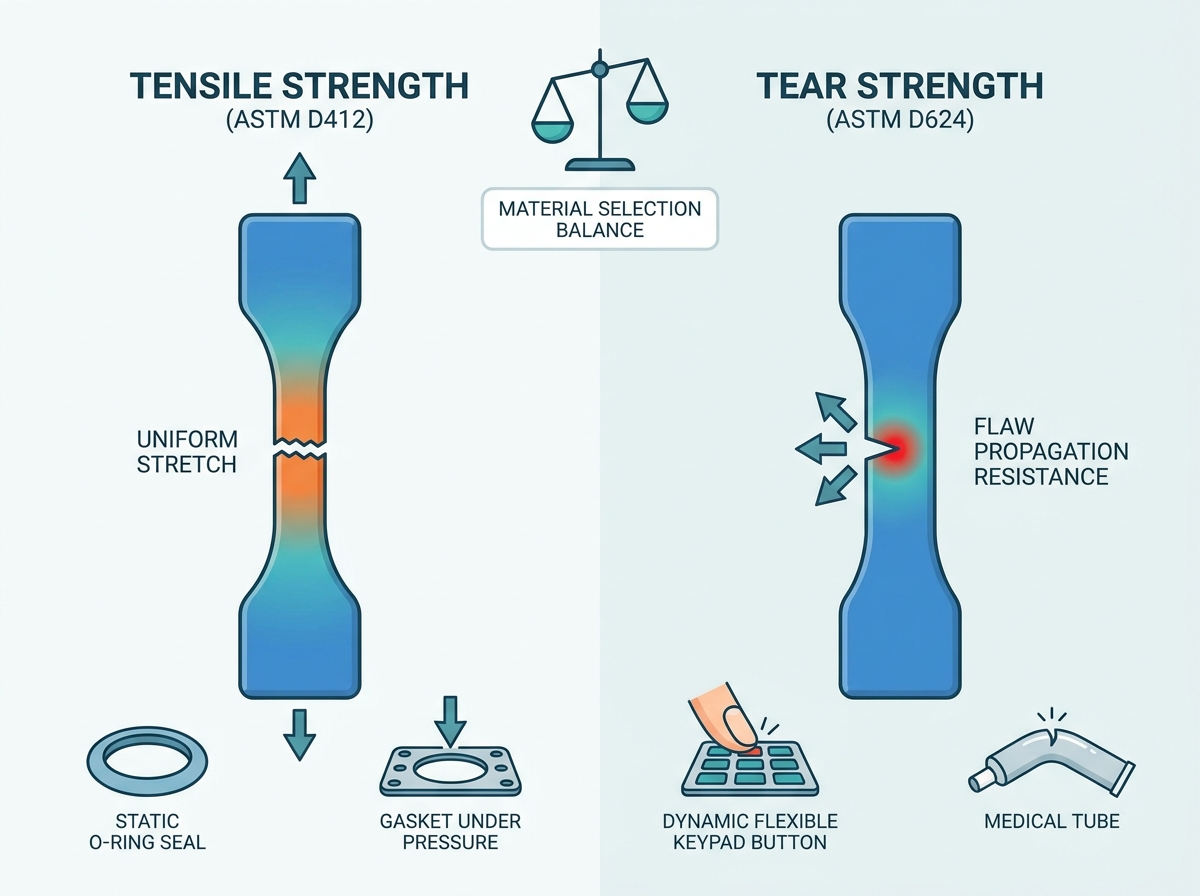
Tensile strength measures the force required to pull a flawless silicone sample apart; tear strength measures the resistance to the growth of an existing cut or flaw.
Selecting high tear strength silicone rubber is critical for dynamic applications (e.g., medical tubing, chewables, keypads) and complex mold extractions involving undercuts.
Enhancing one property often requires trade-offs in others; HCR silicone rubber properties can be heavily customized through compounding to balance these metrics.
Material selection must be validated against standardized testing (e.g., ASTM D412 for tensile, ASTM D624 for tear) aligned with end-use environmental stresses.
We define tensile strength as the ultimate stress a material can withstand. It measures how much you can stretch the rubber before it breaks. Engineers test this using the precise ASTM D412 standard. They place a flawless, dumbbell-shaped sample into a tensiometer. The machine pulls the sample steadily until it snaps. This metric directly relates to elongation at break. It also correlates strongly to the material modulus. Modulus dictates how stiff or flexible the rubber feels under a physical load.
Evaluation lens: This metric works best for assessing overall material robustness. Use it primarily for static stretch scenarios. For instance, O-rings under constant tension rely heavily on high tensile limits to maintain a permanent seal.
We define tear strength as the force required to propagate an existing slit. It evaluates how well the rubber stops a flaw from growing. Engineers measure this using the standardized ASTM D624 method. They use specific cut geometries, commonly known as Die B or Die C. These precision dies introduce an intentional notch into the test sample. The testing machine then pulls the sample to see how easily the notch turns into a full tear.
Evaluation lens: This metric proves critical for dynamic real-world scenarios. Products enduring regular abrasion need it desperately. Cyclic loading and accidental sharp contacts also demand exceptionally high resistance to tearing.
Standard silicone grades often excel in pure tensile capabilities. They can stretch significantly without failing if the surface remains perfectly flawless. However, they frequently fail miserably under tear testing. A tiny nick on the edge creates a massive stress concentration point. Once damaged, standard grades rip quickly under minimal applied force. This inherent vulnerability establishes a strong need for specialized formulations. You simply cannot rely on tensile data alone to predict actual field durability.
Improving tear resistance presents a distinct formulation challenge. Chemists must alter the fundamental silica filler load. Typically, they incorporate highly structured fumed silica to reinforce the polymer matrix. They also adjust the polymer chain length carefully. Modifying the cross-linking density changes how the individual molecules interlock. A denser network sometimes stops cuts from spreading. However, achieving this perfect balance requires precise chemical control during the compounding phase.
You must expect trade-offs when modifying rubber formulations. Aggressively increasing tear resistance often changes other critical physical behaviors.
Increased Hardness: Your target Durometer might drift higher than desired.
Decreased Resilience: The rubber might lose some of its natural bounciness.
Compression Set Issues: High-tear materials sometimes suffer from poor compression set, meaning they might not bounce back fully after prolonged squeezing.
Always test these secondary characteristics during your initial evaluation phase.
Manufacturers rely on two primary material categories to solve these challenges.
Liquid Silicone Rubber (LSR):
LSR offers excellent baseline tear resistance natively. Its liquid state allows for high-volume, rapid injection molding. It easily fills complex, thin-walled geometries inside the mold cavity.
High Consistency Rubber (HCR):
This solid, clay-like material provides entirely different manufacturing advantages. HCR silicone rubber properties offer immense flexibility for custom compounding. Chemists can mix specific additives aggressively on a two-roll mill to tailor the exact mechanical response. This makes HCR ideal for heavy-duty extrusion profiles. Calendering applications also benefit heavily from HCR's robust green strength.
Certain applications require pure tensile performance above all else. Static seals and heavy-duty gaskets need to maintain their structural integrity indefinitely. Thick-walled tubing designed to hold high internal pressure also relies heavily on this metric.
Success criteria here focuses entirely on avoiding catastrophic rupture. The material must endure a uniform, consistent load without yielding. If the operating environment lacks sharp edges or abrasive surfaces, tensile capabilities should take the lead in your specification sheet.
Dynamic environments flip the material requirements entirely. Specifying high tear strength silicone rubber becomes mandatory here.
Dynamic Use Cases: Keypads, industrial bellows, and pump diaphragms flex continuously over millions of cycles. Wearable devices experience daily stretching, scraping, and erratic pulling.
Compliance & Safety: Medical devices like catheters navigate abrasive anatomical pathways. Baby products, especially chewables, face extreme localized stress. A small nick from a sharp tooth or surgical instrument must not cause the product to split.
Success criteria focuses heavily on extending product lifespan despite surface damage. The part must survive localized trauma safely without experiencing a complete structural failure.
Engineering teams need a quick heuristic to weigh these competing risks. Evaluate your static load requirements against your dynamic environmental hazards. Use the following decision matrix to guide your initial material selection.
Material Selection Decision Matrix
Application Type | Primary Environmental Stressor | Recommended Priority | Example Products |
|---|---|---|---|
Static & Enclosed | Uniform internal pressure, constant compression | Tensile Strength | O-rings, flange gaskets, static seals |
Dynamic & Exposed | Continuous flexing, sharp impacts, abrasion | Tear Strength | Pump diaphragms, wearables, keypads |
Medical & Consumer | Chewing, surgical insertion, stretching | Tear Strength | Teethers, catheters, surgical tubing |
Structural Support | Heavy load bearing, minimal movement | Tensile Strength | Vibration dampeners, heavy mounting pads |
Tear resistance heavily impacts the actual manufacturing floor operations. Parts featuring severe undercuts pose a unique, daily challenge. Machine operators must stretch these newly molded parts forcefully off the hot steel mold core. If the tear limits are too low, the part rips during this aggressive extraction. This leads directly to unacceptable scrap rates and delayed shipments. You must formulate the material specifically to survive the demolding process itself, regardless of its end-use environment.
Post-curing finishing processes also depend intricately on these mechanical metrics. Cryogenic deflashing freezes the molded parts using liquid nitrogen to make the excess flash brittle. A tumbling mechanism then snaps the thin flash off the part edges cleanly. However, ultra-high tear grades resist this snapping action stubbornly. The frozen flash simply bends instead of breaking cleanly. This forces manufacturers into labor-intensive, costly manual trimming operations.
Specifying specialized formulations always increases raw material costs. You must be careful to avoid over-engineering a part just to feel safe. Standard grades often suffice beautifully for basic static applications. Reserve premium high-tear materials strictly for parts facing genuine dynamic hazards. Balancing this ratio keeps your production economically viable while still meeting performance targets.
Buyers must write extremely clear material specifications to ensure success. Vague requirements inevitably lead to inconsistent production batches.
Always specify the required Durometer range first (e.g., 50 ± 5 Shore A).
Clearly list the Minimum Tensile value required.
List the Minimum Tear value required based on ASTM D624 standards.
Do not just ask your supplier for "high strength" rubber. Use exact standardized testing numbers to define your expectations precisely.
We highly recommend starting your validation process with simple material plaques. Mold flat sheets of the chosen compound first. Conduct your physical testing on these inexpensive plaques. Do this critical step before cutting expensive steel for final production tooling. This intelligent strategy prevents costly mold modifications later if the material behaves unexpectedly.
Consult heavily with a custom silicone compounder early in the design phase. They can validate your initial assumptions about formulation trade-offs. Ask them to run Finite Element Analysis (FEA) on your intricate part designs. FEA highlights exactly where stress concentrations will likely cause tearing. A strong partnership ensures you select the perfect compound for both manufacturing and end-use.
Choosing the right mechanical property is never a simple binary choice. It requires a deliberate, careful balance dictated by application hazards and manufacturing methods. Evaluate your product's lifecycle carefully to understand its true environmental stresses. A static gasket and a chewable baby toy demand entirely different formulations. Do not let standard pure-stretch metrics give you a false sense of security. Always account for real-world nicks, cuts, and continuous flexing.
Your next steps should focus on rigorous validation. Request a material consultation to discuss your specific geometric challenges. Review a comprehensive material selection chart to compare various standard and specialty grades. Finally, contact your manufacturing engineering team for a full custom compounding review. Proactive testing today prevents catastrophic failures tomorrow.
A: Yes, this happens frequently. Standard formulations create strong polymer networks capable of significant stretching. However, they often lack the specific filler interactions needed to stop flaw propagation. Once a tiny cut appears, the material rips easily despite its high tensile baseline.
A: Standard silicone grades typically measure between 10 to 15 kN/m (roughly 55 to 85 ppi). High-tear specialty formulations can push these values significantly higher, often reaching 30 to 50 kN/m (170 to 285 ppi). Exact values depend heavily on the target Durometer.
A: The correlation is highly non-linear. Mid-range hardness levels, typically between 40 and 60 Shore A, usually offer the best balance of both metrics. Very soft or extremely hard silicones frequently experience a sharp drop-off in their ability to resist tearing.
A: Chewable items face constant, localized trauma from sharp teeth. If a tooth nicks the surface, the material must not split further. Low tear resistance creates a severe choking hazard. High-tear formulations ensure the product remains fully intact, meeting strict safety and compliance standards.


