

Views: 0 Author: Site Editor Publish Time: 2026-08-03 Origin: Site


High-voltage transmission networks face a strict transition phase. Engineers are actively replacing traditional ceramic and glass materials with advanced polymer composites across substations and power lines. The engineering challenge centers on specifying materials that handle massive mechanical loads while resisting environmental degradation in heavily polluted areas. These components must maintain absolute dielectric integrity over a 30-year lifespan without failure. The silicone rubber post insulator stands as the premier solution for these demands. It combines the flexibility of traditional rubber with the extreme temperature and chemical resistance of modern plastics. This technical evaluation breaks down its core properties and manufacturing modalities. We examine High-Temperature Vulcanizing (HTV) and Liquid Silicone Rubber (LSR) processes in detail. You will learn how to optimize material selection for substation infrastructure and mitigate long-term operational risks in the field.
Superior Environmental Resilience: Silicone rubber uniquely offers hydrophobicity recovery, preventing water filming and significantly reducing the risk of leakage currents in highly polluted or coastal environments.
Fail-Safe Dielectric Properties: Unlike other polymers, silicone rubber remains non-conductive even when degraded by extreme heat, mitigating the risk of runaway arcing.
Corrosion and Outdoor Aging Resistance: The material inherently resists degradation from UV radiation, acid rain, and industrial chemicals, ensuring long-term structural and electrical stability.
Manufacturing Flexibility: Production can be optimized through High-Temperature Vulcanizing (HTV) for heavy-duty applications or Liquid Silicone Rubber (LSR) injection molding for high-volume, precision consistency.
Transmission and substation applications historically relied on porcelain and glass. These materials provided adequate baseline insulation for early electrical grids. However, modern grid demands expose their severe operational drawbacks. Porcelain is exceptionally heavy. This extreme weight requires massive support structures and specialized lifting equipment during installation. Rigging a porcelain post insulator requires heavy machinery, increasing site hazard levels and slowing down construction timelines. Glass and ceramic materials are also highly brittle. They suffer from frequent breakage during transit, installation, and routine maintenance. A minor impact from a dropped tool can compromise the entire unit.
Vandalism remains a persistent threat to glass insulators in remote areas. A single impact shatters the unit, dropping the line. Environmental pollution presents an even greater challenge. Airborne contaminants settle on the rigid surfaces of porcelain and glass. When moisture from fog or light rain mixes with this pollution, it creates a conductive film. This film leads directly to leakage currents and flashovers. Grid operators must implement frequent, labor-intensive washing schedules to maintain baseline performance in coastal or industrial zones. Washing requires specialized trucks, de-ionized water, and scheduled outages, draining maintenance budgets.
The term "silicone rubber" functions as a generic umbrella category. Precise specification is mandatory for engineering procurement. You must differentiate between bulk housing materials and remedial coatings. Manufacturers use High-Temperature Vulcanizing (HTV) and Liquid Silicone Rubber (LSR) to create the actual bulk housing of new composite insulators. These materials undergo specific molding processes to form the weather sheds and protective sheath. They provide the physical bulk and structural weatherproofing required for high-voltage applications.
Room Temperature Vulcanizing (RTV) silicone serves a completely different purpose. Maintenance teams apply RTV as a liquid spray coating over legacy porcelain insulators. It cures at ambient temperatures to provide a temporary hydrophobic surface. RTV does not offer structural integrity. You cannot manufacture a standalone insulator from RTV. It acts merely as a band-aid for aging ceramic infrastructure. Understanding these distinctions ensures you specify the correct polymer state for new substation construction versus legacy grid maintenance.
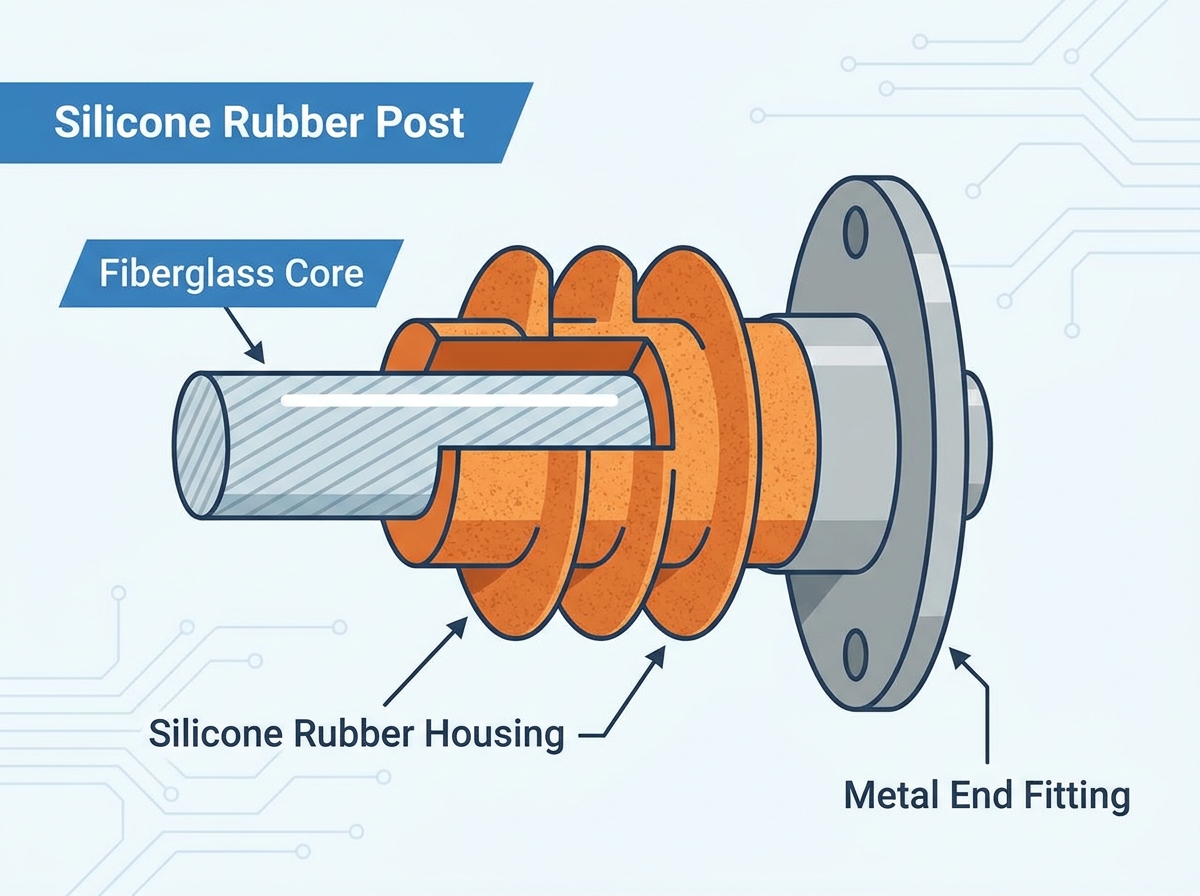
Modern post insulators must meet stringent technical requirements to survive high-voltage environments. The design relies on a dual-component architecture. A central fiberglass reinforced plastic (FRP) core provides the necessary mechanical cantilever strength. This core handles the physical loads of heavy conductors, extreme wind shear, and seismic events. However, the FRP core cannot withstand environmental exposure or electrical tracking on its own. Moisture and UV light will rapidly degrade the fiberglass matrix.
Silicone rubber acts as the critical interface between this structural core and the external environment. It functions as a hybrid shield. The material leverages the pliable, impact-resistant traits of rubber alongside the chemical inertness of advanced plastics. A successful design completely encapsulates the core. It prevents moisture ingress while providing a complex shed profile to maximize creepage distance. The housing must endure continuous electrical stress without degrading. It must stretch and flex with the thermal expansion of the core without losing adhesion.
Hydrophobicity defines the ability of a surface to repel water. Silicone rubber possesses an exceptionally low surface energy. This chemical mechanism causes water to bead up into isolated droplets rather than forming a continuous film. When water cannot form a continuous path, electrical leakage currents cannot flow across the insulator surface. This property alone drastically reduces the risk of pollution-induced flashovers. Engineers measure this using contact angle testing; silicone consistently maintains high contact angles even under heavy precipitation.
The true engineering advantage lies in Hydrophobicity Transfer Material (HTM) properties. Over time, dust, salt, and industrial pollution accumulate on the insulator sheds. Silicone rubber contains low molecular weight (LMW) siloxanes within its polymer matrix. These LMW siloxanes continuously migrate from the bulk material to the surface. They encapsulate the accumulated pollution layer. This migration transfers the water-repellent properties directly to the dirt itself. Even heavily soiled insulators maintain their hydrophobic performance. When heavy rain washes the encapsulated dirt away, the material recovers its baseline hydrophobicity within hours.
Dielectric strength measures a material's ability to withstand high-voltage stress without breaking down. Silicone rubber delivers exceptional dielectric insulation under continuous electrical loads. It prevents the flow of current between the high-voltage conductor and the grounded support structure. The material maintains this insulation integrity across wildly fluctuating environmental conditions. It resists the formation of conductive paths through its bulk volume, ensuring long-term safety for substation personnel.
Thermal stress behavior separates silicone from standard carbon-based polymers. High-voltage environments occasionally generate localized dry-band arcing. This arcing produces intense heat on the insulator surface. When standard plastics burn, they leave behind a conductive carbon track. This track accelerates further arcing and leads to catastrophic failure. When heat damages silicone rubber, it forms silica (SiO2) ash. Silica is inherently non-conductive. This unique chemical reaction prevents runaway tracking and preserves the insulator's operational safety. The ash simply washes away in the next rainstorm, leaving the underlying polymer intact.
Outdoor substation equipment endures brutal temperature extremes. Silicone rubber maintains its physical properties across a massive thermal range. It remains flexible at -50°C without embrittlement or cracking. It also resists degradation at continuous operating temperatures up to +200°C. This thermal stability ensures the weather sheds do not warp, melt, or shatter during severe weather events. The material handles rapid thermal cycling, such as sudden freezing rain on a hot summer day, without micro-cracking.
The chemical structure of silicone relies on an inorganic siloxane backbone (silicon-oxygen bonds). This backbone requires significantly more energy to break than the carbon-carbon bonds found in polymers like EPDM. Consequently, silicone rubber provides inherent resistance to ultraviolet (UV) radiation and ozone exposure. It does not chalk, crack, or harden after decades of direct sunlight. The material also demonstrates extreme resistance to chemical corrosion. It easily withstands prolonged exposure to acid rain, coastal salt fog, and airborne industrial chemicals. Refineries and chemical plants specifically mandate silicone housings for this exact reason.
HTV silicone rubber arrives at the manufacturing facility in a high-viscosity, gum-like state. Production facilities process HTV using heavy-duty extrusion or compression molding techniques. The material requires high temperatures and significant mechanical pressure to cure and form the final shape. Manufacturers often use HTV for large-scale post insulators requiring massive shed diameters. The high viscosity allows the material to hold its shape in large molds before the cross-linking process completes.
The primary advantage of HTV formulations lies in their mechanical robustness. HTV offers exceptional tear strength and physical durability. This makes it ideal for ultra-heavy-duty mechanical requirements where the insulator might face severe physical impacts or extreme wind loads. The dense nature of cured HTV provides a highly resilient barrier against physical abrasion and environmental wear. Sandstorms and heavy ice loads pose little threat to a properly molded HTV housing.
LSR differs fundamentally in its raw state and processing methodology. It consists of a two-part liquid system that utilizes a platinum-cured injection molding process. Manufacturers pump the two liquid components into a static mixer before injecting them into a heated mold cavity. The platinum catalyst triggers an extremely rapid curing process upon exposure to heat. The low viscosity of the un-cured liquid allows it to flow easily into highly intricate mold designs.
LSR manufacturing delivers distinct advantages for precision engineering. The injection molding process produces minimal flash, reducing post-production trimming requirements. It excels at creating dimensionally complex shed profiles with strict tolerances. LSR maintains highly consistent electrical properties across large production runs. The automated nature of the injection process minimizes human error and ensures uniformity in every molded unit. The rapid cure time significantly increases daily production output compared to traditional compression molding.
Selecting between HTV and LSR requires evaluating specific project parameters. HTV generally involves lower initial tooling complexity for simple shapes. However, the compression molding process takes longer per cycle. LSR requires highly specialized, precision-machined molds capable of handling high injection pressures. Once operational, LSR injection molding scales rapidly for high-volume production with significantly shorter cycle times.
Material waste also differs between the two methods. LSR systems utilize closed-loop injection, which minimizes raw material waste. HTV compression molding often generates more excess material that requires removal and disposal. Procurement teams must base their decision framework on the specific post insulator dimensions, the required production run sizes, and the severity of the operating environment.
Parameter | HTV (High-Temperature Vulcanizing) | LSR (Liquid Silicone Rubber) |
|---|---|---|
Raw Material State | High-viscosity gum | Two-part liquid system |
Primary Manufacturing Process | Compression molding / Extrusion | Platinum-cured injection molding |
Mechanical Tear Strength | Exceptionally high | Moderate to high |
Production Cycle Time | Longer cure times | Rapid cure times |
Dimensional Precision | Good for large, simple profiles | Excellent for complex, precise sheds |
Material Waste | Higher (requires trimming) | Minimal (closed-loop system) |
Ideal Application | Ultra-heavy-duty, large-diameter insulators | High-volume, highly consistent production runs |
The most critical failure point in any composite insulator is the interface between the fiberglass core and the silicone housing. If this seal fails, moisture ingresses into the core matrix. Moisture combined with high electrical stress leads directly to internal tracking, brittle fracture, and catastrophic mechanical failure. Achieving a flawless, monolithic seal is the primary objective of the manufacturing process. Field failures almost always trace back to poor adhesion during the molding phase.
Manufacturers utilize specialized chemical bonding agents (primers) applied directly to the FRP core before molding. The overmolding technique must generate a chemical cross-linking reaction between the silicone rubber and the primed core. Process controls monitor temperature, pressure, and primer application thickness. Any deviation compromises the adhesion integrity. A properly bonded housing will tear within the silicone material itself before it peels away from the fiberglass core. Engineers verify this through destructive pull tests on sample units from every production batch.
Micro-voids present a severe hidden risk in composite insulator manufacturing. These tiny air pockets can form within the silicone matrix or directly at the core interface during molding. Under high-voltage stress, the air inside these voids ionizes. This ionization causes partial discharge. Continuous partial discharge slowly erodes the surrounding polymer, eventually creating a conductive path that destroys the insulator from the inside out.
Rigorous quality control steps are mandatory to prevent void formation. Manufacturers utilize vacuum processing during both material preparation and injection to extract trapped air. Post-production inspections rely on advanced diagnostic tools. Ultrasonic testing and X-ray inspection allow engineers to peer inside the opaque silicone housing. These non-destructive testing methods verify the complete absence of internal voids before the unit ships to the field. Routine corona discharge testing further validates the internal dielectric integrity.
Procurement teams must demand strict adherence to international testing frameworks. IEC 61952 dictates the specific mechanical and electrical testing protocols for composite post insulators. This standard ensures the unit can handle designated cantilever loads without excessive deflection. IEC 62217 governs the polymeric interfaces and housing materials, verifying their resistance to environmental degradation. Compliance is not optional; it is the baseline for grid safety.
Manufacturers must provide documented evidence of tracking and erosion resistance. The 1000-hour salt fog test serves as a critical benchmark. During this test, the insulator endures continuous high voltage while exposed to a highly conductive saline mist. Passing this test validates the material's long-term operating performance in severe coastal or industrial environments. Always verify these compliance certificates during the vendor auditing process. Request the raw test data, not just the summary certificate.
Replacing porcelain with silicone rubber fundamentally changes project logistics. Composite insulators weigh 50% to 70% less than their ceramic counterparts. This massive weight reduction directly impacts freight operations. You can pack significantly more units into a standard shipping container without exceeding weight limits. This efficiency lowers transportation costs and simplifies international logistics for large-scale substation projects.
Weight Reduction: Composite units weigh a fraction of porcelain, allowing more units per shipping container and reducing freight costs.
Impact Resistance: The flexible sheds absorb shocks during transit, eliminating the need for excessive crating and padding.
Zero Breakage: Units arrive at the job site intact, eliminating the need to order excess inventory to cover transit damage.
Field installation teams experience immediate benefits when handling composite units. The reduced weight means crews can often maneuver smaller post insulators by hand. For larger transmission units, standard bucket trucks can handle the lifting. You no longer need to schedule heavy cranes just to position an insulator. This flexibility accelerates construction timelines and reduces heavy equipment rental costs.
The rugged nature of the silicone housing protects the unit during the chaotic rigging process. Tools dropped against the sheds simply bounce off. Cables dragging across the surface will not chip or shatter the weather sheds. This durability reduces installation anxiety and prevents costly rework caused by accidental damage during the final stages of construction.
Request comprehensive material data sheets from potential vendors to verify the specific siloxane content and UV resistance ratings of their polymer formulations.
Audit the manufacturer's core-to-housing bonding process, ensuring they utilize vacuum-assisted molding and automated primer application to prevent moisture ingress.
Demand certified test reports for IEC 61952 and IEC 62217 compliance, specifically looking for successful completion of the 1000-hour salt fog tracking and erosion test.
Select HTV materials for substation projects requiring massive shed diameters and extreme mechanical impact resistance.
Specify LSR injection molding for high-volume procurement where dimensional consistency and rapid production scaling are primary project requirements.
A: The standard industry expectation ranges from 25 to over 30 years. Actual longevity depends heavily on the severity of the operating environment, the specific formulation's resistance to outdoor aging, and the manufacturer's quality control regarding core-to-housing adhesion.
A: Silicone rubber maintains a highly hydrophobic surface. This prevents water from forming continuous conductive films across the insulator. Without a continuous water path, leakage currents cannot flow, thereby stopping the localized heating and evaporation cycle that causes dry-band arcing.
A: EPDM is a carbon-based polymer, while silicone utilizes an inorganic siloxane backbone. Silicone provides vastly superior UV resistance and unique hydrophobicity recovery. Furthermore, when damaged by heat, silicone degrades into non-conductive silica ash, whereas EPDM leaves a highly conductive carbon track.
A: Yes. They are the ideal choice for coastal environments. Low molecular weight siloxanes continuously migrate to the surface, encapsulating salt and industrial pollution. This mechanism maintains the insulator's dielectric strength and prevents flashovers without requiring frequent washing.
A: Liquid Silicone Rubber (LSR) injection molding is the most efficient method for high-volume production. It utilizes a platinum-cured process that delivers extremely fast cure times, automated processing, minimal material waste, and highly consistent electrical properties across large batches.
A: Unlike standard plastics that melt and carbonize into conductive tracks under intense heat, silicone rubber undergoes a different chemical reaction. It degrades into silica (SiO2) ash. This ash remains an electrical insulator, preventing runaway arcing and catastrophic failure.
A: Yes. The material demonstrates exceptionally high resistance to chemical degradation. Its stable chemical structure easily withstands prolonged exposure to industrial airborne chemicals, acid rain, and salt fog, making it highly reliable in harsh outdoor substation environments.


