

Views: 0 Author: Site Editor Publish Time: 2026-10-31 Origin: Site


Permanent deformation acts as the primary failure mode for industrial seals. Engineers identify this failure as compression set. It leads directly to costly leaks, compromised enclosures, and critical compliance failures. Silicone holds global recognition for its outstanding thermal stability. However, elastomeric materials behave differently under mechanical pressure. Not all silicone formulations handle sustained compressive loads equally.
Your dynamic sealing environments demand absolute reliability over long lifespans. High Consistency Rubber (HCR) offers a distinct, verifiable advantage for these extreme situations. Industry professionals prefer it for predictable structural integrity. This guide breaks down how you can evaluate and specify HCR. We will explore methods to mitigate sealing risks in critical applications. You will learn to navigate testing standards, compare material architectures, and avoid manufacturing pitfalls.
Silicone rubber compression set measures a material's inability to return to its original thickness after sustained compression; lower percentages indicate superior seal longevity.
HCR silicone rubber generally provides superior mechanical strength and lower compression set profiles compared to standard RTV or baseline LSR options.
Achieving an optimal compression set for silicone gaskets requires specifying the correct curing agent (Platinum vs. Peroxide) and mandating strict post-curing protocols.
Rely on ASTM D395 (Method B) testing data rather than generic material data sheets when qualifying a manufacturing partner.
Elastomeric seals function through basic mechanical resistance. You compress an elastomer between two rigid metal or plastic flanges. The material pushes back against those mating surfaces. This continuous opposing force creates a tight, reliable environmental barrier. Engineers use compression set values to quantify the gradual loss of this push-back memory over months and years.
When a gasket remains under pressure, its internal polymer chains experience stress relaxation. They slowly untangle and realign into the compressed shape. High permanent deformation values indicate structural breakdown within the material matrix. Environmental temperatures naturally fluctuate day and night. Hardware flanges expand and contract due to thermal cycling. If system pressure spikes occur, a deformed gasket cannot expand fast enough to fill the resulting micro-voids. This loss of elasticity directly causes catastrophic seal failure. Aggressive fluids, external moisture, or sensitive gases can then easily bypass the compromised barrier.
Material failure inevitably leads to severe business impacts. When seals fail in remote field applications, manufacturers face painfully expensive warranty claims. Electronics enclosures may instantly lose their official IP (Ingress Protection) ratings. This ruins brand credibility and consumer trust. Industrial facilities also suffer unexpected maintenance downtime, completely halting profitable production lines. Choosing an inferior sealing material creates massive systemic losses across the entire supply chain.
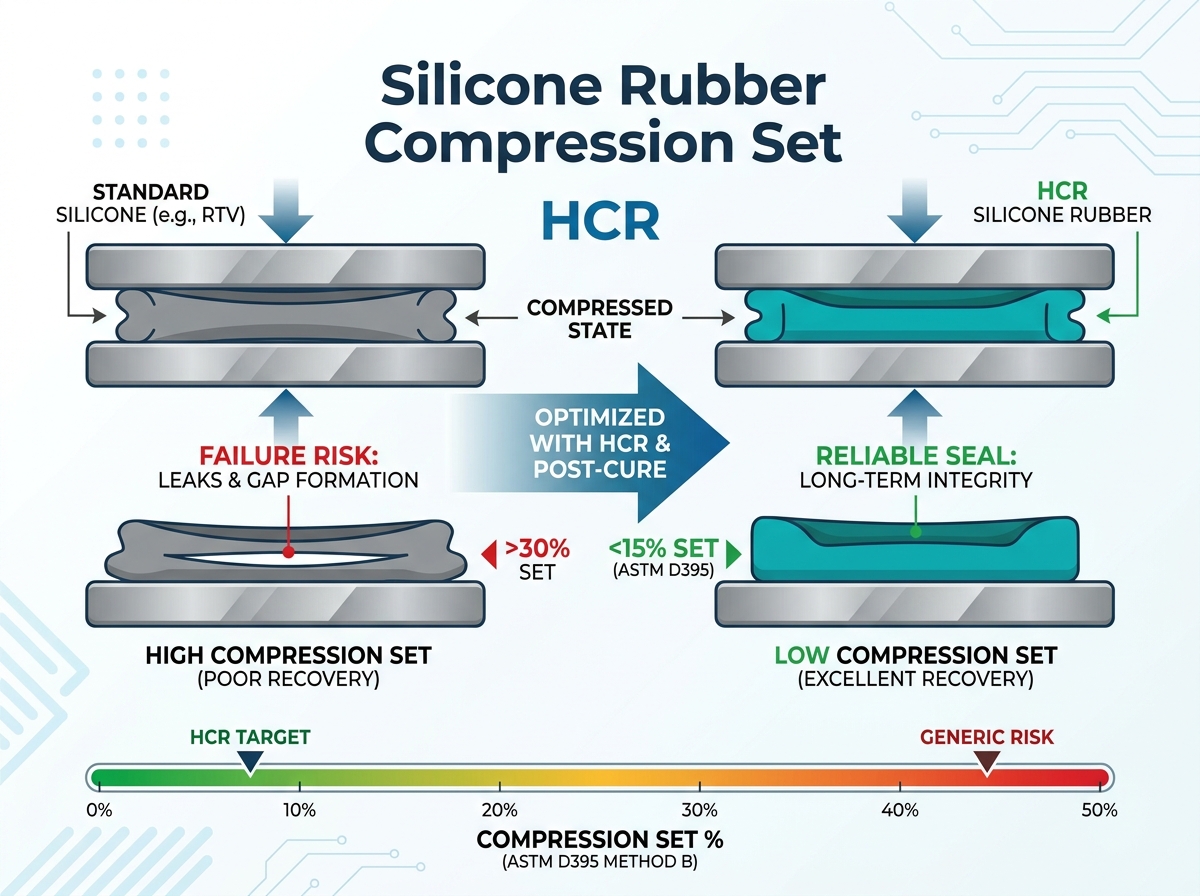
Engineers cannot rely on visual inspections to predict long-term seal longevity. You must utilize standardized laboratory testing to verify material performance. ASTM D395 Method B serves as the industry's undisputed baseline metric. It evaluates permanent deformation under constant deflection.
During this rigorous test, technicians place a material specimen between two steel plates. They compress the specimen to exactly 25% of its original measured thickness using precision spacers. They place this clamped fixture into a high-temperature oven for a predetermined time. Typical testing durations range from 22 to 70 hours. Afterward, they remove the fixture, release the pressure, and let the specimen recover on a specialized cooling rack. The final micrometer measurement shows exactly how much thickness the rubber lost permanently.
Buyers must understand how to interpret this resulting data effectively. A lower percentage number always indicates superior elastic recovery.
Typical Deformation Ranges and Risk Levels
Test Result Percentage | Performance Rating | Typical Application Suitability |
|---|---|---|
10% - 15% | Excellent | Critical aerospace parts, medical devices, and high-pressure fluid systems. |
16% - 25% | Good | Standard automotive seals, outdoor IP67 enclosures, and general electronics. |
26% - 40% | Marginal | Low-pressure dust seals, indoor housings, and non-critical static joints. |
Greater than 40% | High Risk | Not recommended for long-term liquid sealing or dynamic environments. |
Skeptical evaluation of supplier data remains absolutely crucial. Some compounders test their silicone rubber compression set at simple room temperature. This deceptive practice produces artificially attractive numbers on technical datasheets. It actively misleads procurement teams. Reliable data must strictly reflect the application's actual operating conditions. We strongly recommend demanding laboratory test reports conducted at 150°C to 200°C for high-heat environments.
Material architecture heavily influences long-term sealing success. High Consistency Rubber (HCR) features an extremely dense, highly entangled polymer chain structure. Industry veterans often refer to HCR simply as solid silicone. These high-molecular-weight chains inherently resist permanent displacement under heavy mechanical loads. They maintain their tangled matrix even when squeezed aggressively.
When evaluating materials, HCR silicone rubber shows distinct comparative advantages across various metrics:
Versus RTV (Room Temperature Vulcanizing): Standard RTV silicones lack the dense cross-linking networks needed for heavy structural loads. They often deform quickly under high flange torque. HCR offers vastly superior mechanical integrity. You can predict its physical behavior with far greater accuracy over a ten-year product lifespan.
Versus LSR (Liquid Silicone Rubber): LSR performs exceptionally well for high-volume, highly intricate injection molding processes. However, premium HCR often provides more robust physical properties for sheer durability. Engineers prefer HCR for heavy-duty, large-format, or extreme-temperature static seals. Its dense, clay-like raw nature handles aggressive metal-to-metal flange pressures much better than standard liquid formulations.
Chemists can highly customize HCR formulations. By incorporating specific treated fumed silica fillers, engineers drive the permanent deformation numbers exceptionally low. They achieve this precise chemical balance without sacrificing essential tensile strength or elongation properties. You get a robust seal holding its shape while remaining physically tough.
Specifying a reliable seal requires more than picking a generic base material. You must balance several physical and environmental variables simultaneously to optimize the final molded part.
First, you need to match the material hardness correctly. We measure this hardness on the Shore A durometer scale. An inverse relationship often exists between durometer and permanent deformation capabilities. Very soft silicones (typically 20-30 Shore A) compress easily under light loads. However, they frequently suffer from higher permanent set over time. Conversely, extremely hard materials (70-80 Shore A) resist compression entirely. They make hardware assembly incredibly difficult and require massive clamping forces. Mid-range options (40-60 Shore A) usually provide the ultimate sweet spot. They offer optimal elastic memory and necessary installation flexibility.
Next, consider the cross-sectional thickness of the seal. The physical dimensions of the profile directly impact its ability to resist permanent damage.
O-Ring Cord Diameter: Thicker cross-sectional cords generally retain their circular shape better than very thin micro-cords. They distribute compressive stresses across a larger internal volume.
Flat Gasket Thickness: A flat profile needs sufficient material volume to maintain adequate push-back force. If you design it too thin, the gasket bottoms out quickly and loses sealing efficacy.
Profile Geometry: Custom extruded profiles feature unique shapes like hollow D-rings or P-seals. These hollow centers behave differently than solid cross-sections and require specialized finite element analysis.
Finally, account for operating environment modifiers. Pure mechanical compression represents only one piece of the engineering puzzle. Harsh chemical exposure directly attacks the polymer backbone. Prolonged contact with industrial steam accelerates polymer degradation through hydrolysis. You must aggressively factor these external stressors into your baseline calculations. Doing so ensures an optimal compression set for silicone gaskets.
Even the best formulated HCR compound will fail if a factory processes it incorrectly. Exact manufacturing variables dictate the ultimate performance of the physical seal.
Curing system selection plays a massive, undeniable role in shaping the internal polymer network. Material manufacturers primarily choose between peroxide and platinum catalytic systems.
Peroxide cure systems remain traditional and highly cost-effective for large production runs. However, the free-radical chemical reaction leaves behind acidic byproducts inside the rubber. If factories do not strictly control these residues, they severely degrade the material's ability to bounce back.
Platinum (addition) cure systems utilize a completely different chemical reaction. They yield a much tighter, more uniform cross-linked molecular network. This advanced process produces exceptionally clean off-gassing. It leaves virtually no harmful chemical residues inside the matrix. Consequently, platinum-cured parts exhibit significantly lower permanent deformation. Engineers mandate this curing method for medical-grade devices, food-processing equipment, and mission-critical aerospace seals.
Beyond the primary press cure, buyers must ruthlessly enforce the post-curing mandate. Raw HCR molded parts desperately require a secondary oven bake.
Best practices and common mistakes include:
Crucial Step: Baking parts at 200°C for two to four hours drives off volatile siloxane byproducts completely.
Common Mistake: Skipping the post-cure phase entirely to save money and accelerate shipping times.
Common Mistake: Baking parts at temperatures too low to activate the necessary secondary chemical cross-linking.
Common Mistake: Overcrowding the industrial oven. This traps volatile byproducts near the seals, preventing proper off-gassing.
This mandatory post-curing process stabilizes the internal chemical structure once and for all. Skipping this vital step to save a few pennies guarantees a high compression set. It inevitably leads to premature seal failure in the field.
Low compression set is never an automatic, default feature of basic silicone rubber. It remains a carefully engineered outcome. You achieve this specific outcome by actively choosing robust HCR materials. You must specify the correct platinum cure system for your application. Finally, you must mandate and execute proper post-curing oven procedures. Outstanding material properties matter greatly, but strict manufacturing discipline matters equally.
To protect your costly assemblies, you must take proactive engineering next steps. Always request certified, independent ASTM D395 test reports from your potential manufacturing suppliers. Outright refuse to accept generic marketing data sheets tested only at comfortable room temperatures. Ask specific, targeted questions about their internal post-curing oven protocols and batch-control tracking methods. Finally, order small prototype batches. Subject these prototypes to accelerated life cycle testing before approving full-scale production. Validating these metrics early ensures your custom seals will perform flawlessly for many years.
A: Typically, you should look for results under 20% when tested at application temperatures. This threshold ensures reliable IP67 or IP68 protection over a 10-plus year lifespan, preventing water and dust ingress during seasonal temperature swings.
A: Once molded and finalized, it cannot be improved. Permanent improvement requires reformulating the raw compound, switching to a tighter platinum cure system, or increasing the post-cure time and temperature during the manufacturing phase.
A: Elevated temperatures accelerate polymer relaxation and cross-link breakage. While silicone easily outperforms most organic rubbers in heat resistance, you must run laboratory tests at peak application temperatures to ensure real-world viability and predict accurate failure rates.


