

Views: 0 Author: Site Editor Publish Time: 2026-11-10 Origin: Site


Every hardware manufacturing project eventually faces a critical crossroads. You must choose between the low-barrier entry of room-temperature tooling and the high-capital, high-yield environment of liquid injection molding. This initial tooling decision heavily dictates your production timeline and long-term profit margins. Misjudging this choice leads to major financial consequences. You might face exorbitant, unrecoverable tooling costs for untested, unproven parts. Conversely, you could encounter crippling per-unit costs and severe supply chain bottlenecks once you attempt to scale. We need a clear framework to navigate this complex challenge. Evaluating both materials based on production volume, upfront capital expenditure (CapEx), and strict performance requirements is absolutely essential for success. In this guide, we will break down the engineering and business logic behind each manufacturing method. You will learn exactly when to deploy flexible room-temperature options and when to commit to heavy-duty automated production.
RTV (Room Temperature Vulcanizing) is optimal for prototyping, art casting, and low-volume runs (1–500 units) due to near-zero tooling costs, but it suffers from slow cycle times and short mold life.
LSR (Liquid Silicone Rubber) requires high initial CapEx for machined steel molds but delivers extreme precision, rapid cycle times, and the lowest per-unit cost at scale (10,000+ units).
The tipping point between RTV silicone vs LSR usually hinges on expected production volume and strict compliance requirements (e.g., ISO-certified medical or food-grade applications).
Manufacturing choices depend heavily on where your product lives in its lifecycle. You must first assess your product maturity. Are you currently validating a new design, or are you moving aggressively toward the mass market? Answering this question simplifies material selection immediately.
Hardware development cycles move through distinct phases. You start with basic concepts. You move into functional testing. Finally, you scale up for global distribution. Your choice of materials must match your current phase perfectly.
The RTV approach serves as an excellent bridge-to-production strategy. Using two part silicone mold making allows engineers to cast urethane or epoxy parts rapidly. You avoid investing heavy capital in rigid metal tooling. It lets you test form, fit, and function early. Engineers rely heavily on this bridging concept. You might need to supply beta testers with 100 physical units. Machining a steel mold for a beta test wastes capital. Instead, a flexible mold gets parts into user hands quickly.
On the other hand, the LSR approach represents a serious commitment to your final design. Upgrading to liquid silicone rubber injection molding demands high-pressure, high-temperature automated equipment. You need LIM (Liquid Injection Molding) machines and highly precise steel molds. You cannot easily change part designs once you cut steel.
Define your primary success criteria before spending any money. You must know what matters most right now. Is your goal achieving rapid speed to your first physical prototype? Or do you need the absolute lowest cost per 100,000th unit? Setting this priority drives the rest of your production strategy.
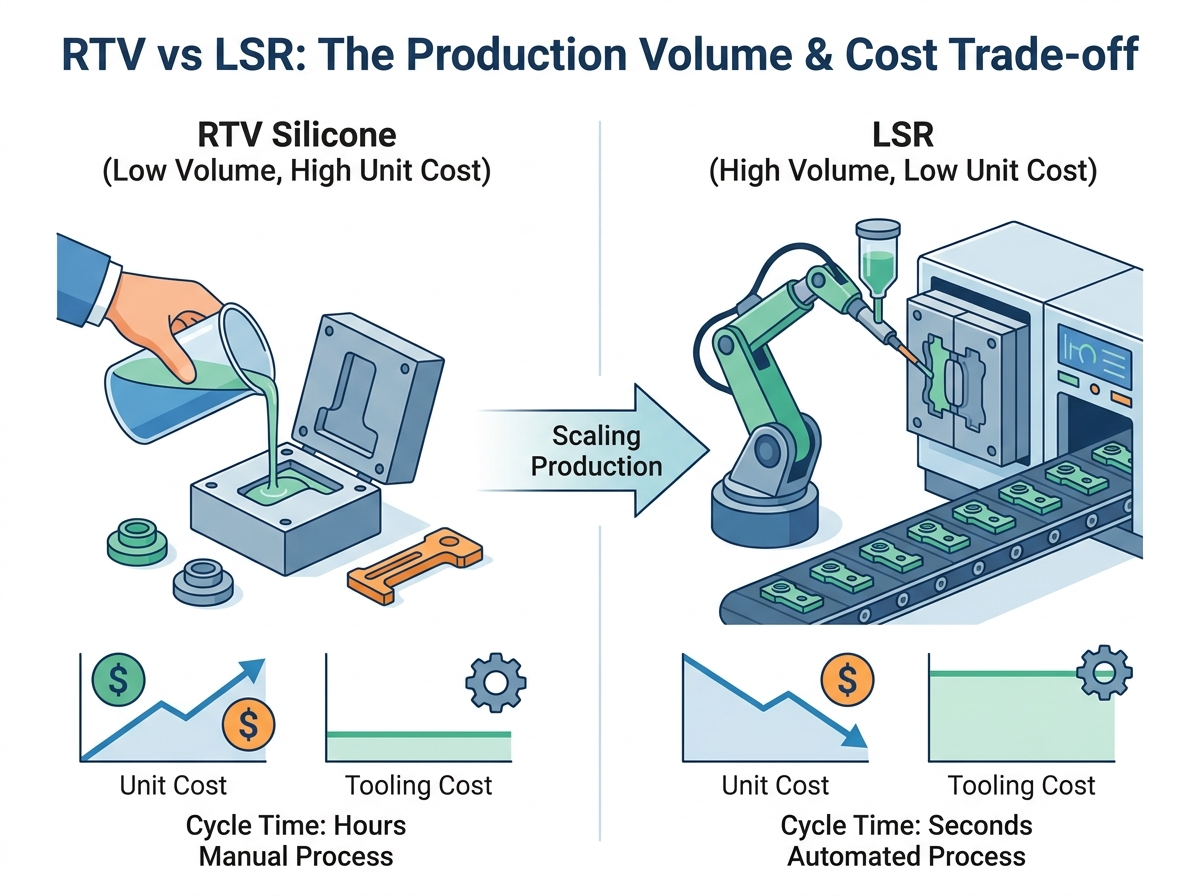
Speed and accessibility define room-temperature systems. They offer nearly frictionless implementation for agile engineering teams. You do not need heavy machinery, presses, or complex thermal curing systems. The material cures reliably at room temperature on a standard workbench.
Cost dynamics heavily favor this method early on. Tooling costs remain incredibly minimal. Engineers often build these flexible tools for under $500. However, you pay for this cheap tooling in production speed. Cycle times are measured in hours, not seconds. This slow output makes mass production completely economically unviable.
You must understand specific implementation realities before proceeding:
Human error risks: Manual processes introduce inherent risks. The mixing phase often creates human error. Technicians might trap air bubbles in the material. Skipping the vacuum degassing step ruins the final part.
Incomplete curing: Poor ratio measurements prevent the material from cross-linking properly. You end up with a sticky, unusable mold.
Mold degradation: These tools do not last forever. RTV molds typically fail or lose dimensional accuracy after 20–50 pulls. Aggressive polyurethane casting resins contain harsh chemicals. These chemicals extract vital oils from the flexible mold during curing. The mold becomes brittle over time.
Apply strict shortlisting logic here. Choose RTV for initial prototyping phases. Use it for short-run legacy replacement parts where demand remains low. It also excels for highly complex geometries. Sometimes rigid tooling would require impossible undercuts. A flexible mold becomes the only viable option to release the part.
When you transition to mass manufacturing, the rules change entirely. Liquid systems offer incredible high-yield economics. Once you pay for the rigid steel mold, automated injection changes everything. Cycle times drop drastically from several hours to mere seconds. You typically see 30–90 seconds per shot.
You also gain massive material superiority at scale. Platinum-cured materials offer unparalleled thermal stability and tear resistance. They exhibit fantastic biocompatibility for sensitive applications. These parts maintain their core physical properties across extreme temperature variances.
However, you must navigate strict implementation realities and risks:
Expensive Tooling: Tooling requires precision CNC machining and EDM (Electrical Discharge Machining). These rigid steel molds often cost anywhere from $5,000 to $30,000 or more.
Design Lock-In: You cannot iterate easily. Modifying a steel mold to accommodate simple design changes is highly expensive. It routinely delays production by weeks.
Specialized Partners: This process requires specialized injection molding partners. It is strictly not an in-house DIY solution. You must outsource to capable vendors.
Your shortlisting logic should focus entirely on scale. Choose this method when forecasting high production volumes. We typically recommend it for projects exceeding 10,000 units per year. Use it when you require flashless, waste-free parts. It is also mandatory when navigating stringent FDA regulations or medical device compliance standards.
When analyzing RTV silicone vs LSR, you must evaluate several distinct business and engineering metrics. Finding the right balance ensures your project remains profitable.
The core financial debate centers on balancing upfront capital against variable costs. You must carefully compare the high unit cost and low CapEx of RTV against the low unit cost and high CapEx of LSR. Early on, manual pouring saves thousands of dollars in tooling. Yet, expensive manual labor drives the per-part cost up significantly over time.
You need a standard break-even analysis framework based on projected volume. At 500 parts, the expensive steel mold makes no financial sense. Somewhere between 1,000 and 5,000 parts, the lines cross. The automated speed of injection molding eventually absorbs the massive upfront tooling expense.
Comparative Break-Even Matrix
Metric | RTV Process | LSR Injection Molding |
|---|---|---|
Upfront Capital (CapEx) | Extremely Low (<$500) | Extremely High ($10,000+) |
Per-Unit Cost at Volume | High (Labor intensive) | Low (Automated processing) |
Typical Cycle Time | 4 to 24 Hours | 30 to 90 Seconds |
Tooling Durability | 20 to 50 Pulls | 100,000+ Cycles |
Ideal Application | Prototyping & Short Runs | Mass Production & High Compliance |
Speed determines your supply chain resilience. We must evaluate the heavy manual labor dependencies of pouring molds by hand. A technician must mix, pour, vacuum degas, and demold every single batch. This creates an obvious production ceiling. You simply cannot scale manual labor infinitely without introducing quality defects.
Conversely, injection systems unlock true scalability. You tap into the "lights-out" automation potential of modern manufacturing. A liquid injection machine operates with extreme precision. It pumps equal parts of base and catalyst through a static mixer. The machine injects this mixed material directly into a heated steel cavity. The high heat triggers an immediate chemical cross-linking process. The part cures solidly in seconds. A single machine can produce thousands of flawless units over a weekend without direct human intervention.
Engineering tolerances dictate material selection just as much as budget does. Room-temperature vulcanizing offers amazing flexibility for demolding parts. You can easily pull these flexible molds over deep, complex undercuts. However, the material shrinks slightly upon curing. This shrinkage affects tight tolerances negatively.
Liquid injection systems provide near-zero shrinkage. They deliver superior chemical resistance in harsh operational environments. You achieve much tighter dimensional tolerances consistently. These precise tolerances are absolutely required for critical applications like fluid gaskets, medical tubing, and environmental seals.
Rushing into mass production often ruins hardware startups. The transition between these two distinct manufacturing methods requires careful planning. You should rarely jump straight to expensive injection systems. Always validate your physical part design via cheaper methods first.
We call this the "bridge-to-volume" transition. You design your initial parts for injection molding principles. However, you cast the first 500 units using room-temperature methods. You test these parts rigorously in the field. You gather user feedback and tweak the CAD geometry. Only then do you write a purchase order for a heavy steel mold.
We often see teams ignore the hidden costs in manual production. You face incredibly high labor overhead to run a casting shop. You will encounter high scrap rates from simple manual mixing errors. Frequent mold replacement also drives up costs. As mentioned earlier, aggressive urethanes destroy flexible molds quickly, forcing constant remaking of the master tool.
Likewise, automated production carries its own hidden expenses. You must plan for extended lead times for tool cutting. A complex steel mold often takes 4 to 12 weeks to fabricate. You will face cold runner system maintenance costs over time. Contract manufacturers also enforce strict minimum order quantity (MOQ) requirements. You cannot order just 50 parts from a high-volume factory.
Quality assurance looks entirely different for each method. You will spend time managing flash in injection processes if the tool wears down over hundreds of thousands of cycles. Conversely, you must constantly manage and trim ugly seam lines found on manually poured molds. Both require distinct inspection protocols and dedicated labor hours.
Selecting the right polymer strategy defines your production success. The summary of evidence points to a clear financial reality. Low-barrier tooling protects your critical cash flow during R&D and early validation. High-volume injection molds protect your long-term profit margins during mass production.
You can rely on a straightforward decision rule of thumb to guide your team:
Under 1,000 units or actively validating a design -> Source a premium 2-part RTV.
Proven design, strict tolerances, 10,000+ units -> Request a tooling quote for LSR injection molding.
Take definitive action on your supply chain today. Consult directly with a tooling engineer to discuss your specific geometry. We recommend requesting a material sample or an initial tooling quote based on your current CAD files. Lock in your budget expectations early to avoid surprises.
A: No. RTV is designed for gravity pouring or low-pressure casting at room temperature. The pressures and thermal requirements of injection molding require LSR or High Consistency Rubber (HCR).
A: Generally, yes. LSR typically features superior tensile strength, tear resistance, and elongation properties, particularly under extreme thermal stress, due to its platinum cure system and automated high-pressure processing.
A: An RTV mold degrades after a few dozen to a few hundred cycles. A machined steel LSR mold is guaranteed for hundreds of thousands, often up to a million, cycles before requiring major maintenance.


