

Views: 0 Author: Site Editor Publish Time: 2026-08-06 Origin: Site


High-voltage and medium-voltage infrastructure relies on the structural and electrical integrity of post insulators. Premature material degradation leads to flashovers, costly maintenance, and catastrophic grid failures. Transitioning from traditional porcelain or glass to composite polymer insulators requires selecting an elastomer that can withstand severe environmental stress, UV radiation, and continuous electrical loads. Selecting the wrong silicone formulation risks poor bonding, tracking, and loss of hydrophobicity. We see these failures in the field when substandard materials face heavy coastal salt fog or industrial pollution. This guide provides a technical evaluation framework for specifying silicone rubber for post insulators, comparing material types, evaluating critical performance metrics against international standards, and mitigating manufacturing risks.
Material Selection Dictates Lifespan: High-Temperature Vulcanized (HTV) and Liquid Silicone Rubber (LSR) are the primary choices for composite post insulators, each offering distinct manufacturing and performance trade-offs.
Hydrophobicity is Non-Negotiable: The ability of the silicone to maintain and transfer hydrophobicity to pollution layers is the critical differentiator for preventing leakage currents in contaminated environments, giving it a distinct advantage over organic rubbers like EPDM.
Filler Optimization is Critical: Balancing Alumina Trihydrate (ATH) or silica fillers is required to achieve optimal tracking and erosion resistance (IEC 60587) without compromising mechanical tear strength.
Dual Insulation Properties: Premium silicone formulations act as both electrical and thermal insulators, preventing localized heat buildup and thermal runaway near metal end fittings.
Manufacturing Compatibility Matters: The chosen silicone rubber must align with the manufacturer's molding capabilities (injection vs. extrusion/compression) and ensure a flawless chemical bond to the fiberglass (FRP) core.
Traditional ceramic and glass insulators present severe operational disadvantages in modern grid infrastructure. They are heavy, fragile, and perform poorly in polluted environments. Heavy contamination on glass or porcelain surfaces creates continuous water films during rain or fog. These water films conduct electricity, leading to leakage currents, dry-band arcing, and eventual flashovers. Substation operators historically mitigated this by scheduling frequent, labor-intensive washing cycles.
The industry shift toward composite insulators directly addresses these vulnerabilities. The fundamental advantage of silicone lies in its inorganic polymer structure. The backbone of the silicone polymer consists of alternating silicon and oxygen atoms (Si-O bonds). This siloxane backbone possesses a bond energy of approximately 444 kJ/mol. In contrast, the carbon-carbon (C-C) bonds found in organic polymers have a bond energy of only 356 kJ/mol. This higher bond energy means the siloxane backbone requires significantly more energy to break down. It provides exceptional thermal stability, low surface energy, and superior dielectric properties. When exposed to extreme temperatures or high-voltage corona discharges, the siloxane backbone remains intact long after organic materials degrade.
Ethylene Propylene Diene Monomer (EPDM) saw widespread use in early composite insulators. EPDM offers excellent mechanical toughness and resists physical tearing. However, silicone rubber rapidly overtook EPDM as the superior choice for post insulators. The deciding factor is hydrophobicity. Silicone rubber possesses the unique ability to recover its water-repellent nature after electrical arcing and transfer this hydrophobicity to accumulated pollution layers. Low molecular weight components within the silicone migrate through the dirt, encapsulating the particles and preventing continuous moisture films. This drastically reduces dry-band arcing, a feature EPDM cannot replicate.
Post insulators operate under different mechanical constraints compared to standard suspension insulators. While suspension insulators primarily handle tensile stress, post insulators must bear significant compressive and cantilever mechanical loads. They support heavy busbars and switchgear components. The silicone housing must remain flexible enough to accommodate the slight bending of the internal fiberglass reinforced plastic (FRP) core under these cantilever loads without cracking or losing adhesion.
Field engineers frequently replace older ceramic units with composite silicone insulators to eliminate specific failure modes:
Vandalism and impact damage that shatters brittle porcelain sheds.
Seismic vulnerability caused by the high mass and rigid nature of ceramic stacks.
Pollution-induced flashovers in coastal areas requiring continuous maintenance.
Thermal cracking from sudden temperature drops during heavy rainstorms.
Selecting the correct base material dictates the manufacturing process and the final performance of the post insulator. The industry relies on two distinct categories of silicone rubber, defined by their molecular weight, curing mechanism, and processing requirements.
HTV silicone rubber features a high molecular weight and presents initially as a highly viscous, gum-like material. Manufacturers process HTV using compression molding, extrusion, or transfer molding techniques. The curing process relies on peroxide catalysts activated by high heat inside the mold.
The primary advantage of HTV is its outstanding mechanical strength and filler capacity. The high viscosity of the base gum allows manufacturers to incorporate massive amounts of functional fillers, specifically Alumina Trihydrate (ATH). Formulators can push ATH loading up to 50% or 60% by weight. High ATH loading is mandatory for surviving ultra-high voltage (UHV) applications where electrical stress is extreme. HTV boasts a proven, decades-long field history in the most demanding electrical environments globally.
Processing HTV presents distinct challenges on the factory floor. The material requires longer curing times inside the mold, slowing down production rates. The high temperatures needed for vulcanization demand significant energy consumption. Because HTV requires intensive mechanical mixing on two-roll mills to incorporate the fillers and catalysts, batch-to-batch inconsistency remains a risk if the compounding process lacks strict quality control.
LSR utilizes a lower molecular weight polymer and operates as a two-part liquid system. It cures via a platinum-catalyzed addition reaction. Manufacturers process LSR exclusively through liquid injection molding (LIM) equipment.
LSR excels in manufacturing efficiency. The platinum cure system reacts rapidly when introduced to a heated mold, resulting in exceptionally fast cycle times. The liquid nature of the material allows for highly automated processing with minimal human intervention. LSR flows easily into intricate mold cavities, providing excellent dimensional precision for complex shed profiles. The closed-loop pumping systems ensure highly consistent material properties from one batch to the next.
The trade-offs for LSR involve mechanical limits and formulation constraints. LSR generally exhibits lower initial tear strength compared to premium HTV formulations. The liquid injection process limits the amount of ATH filler that can be added. If the ATH loading becomes too high, the viscosity increases beyond the pumping capacity of the LIM equipment. The specialized injection molding machines and precision-machined molds also require substantial initial capital investment.
RTV silicone cures at room temperature upon exposure to atmospheric moisture. Utility companies use RTV as a remedial spray coating applied to existing, installed porcelain or glass insulators to improve their performance in polluted areas. RTV is not a structural housing material and is never used to manufacture new composite post insulators.
Parameter | HTV (High-Temperature Vulcanized) | LSR (Liquid Silicone Rubber) |
|---|---|---|
Physical State | High viscosity, gum-like solid | Two-part pumpable liquid |
Processing Method | Compression, extrusion, transfer molding | Liquid Injection Molding (LIM) |
Curing Mechanism | Peroxide-catalyzed (heat activated) | Platinum-catalyzed (addition cure) |
Maximum ATH Filler Capacity | Very High (Up to 60% by weight) | Moderate (Limited by pumping viscosity) |
Production Cycle Time | Slower (Requires longer mold time) | Rapid (Fast platinum reaction) |
Typical Voltage Application | HV and UHV (High tracking resistance) | MV and HV (High precision profiles) |
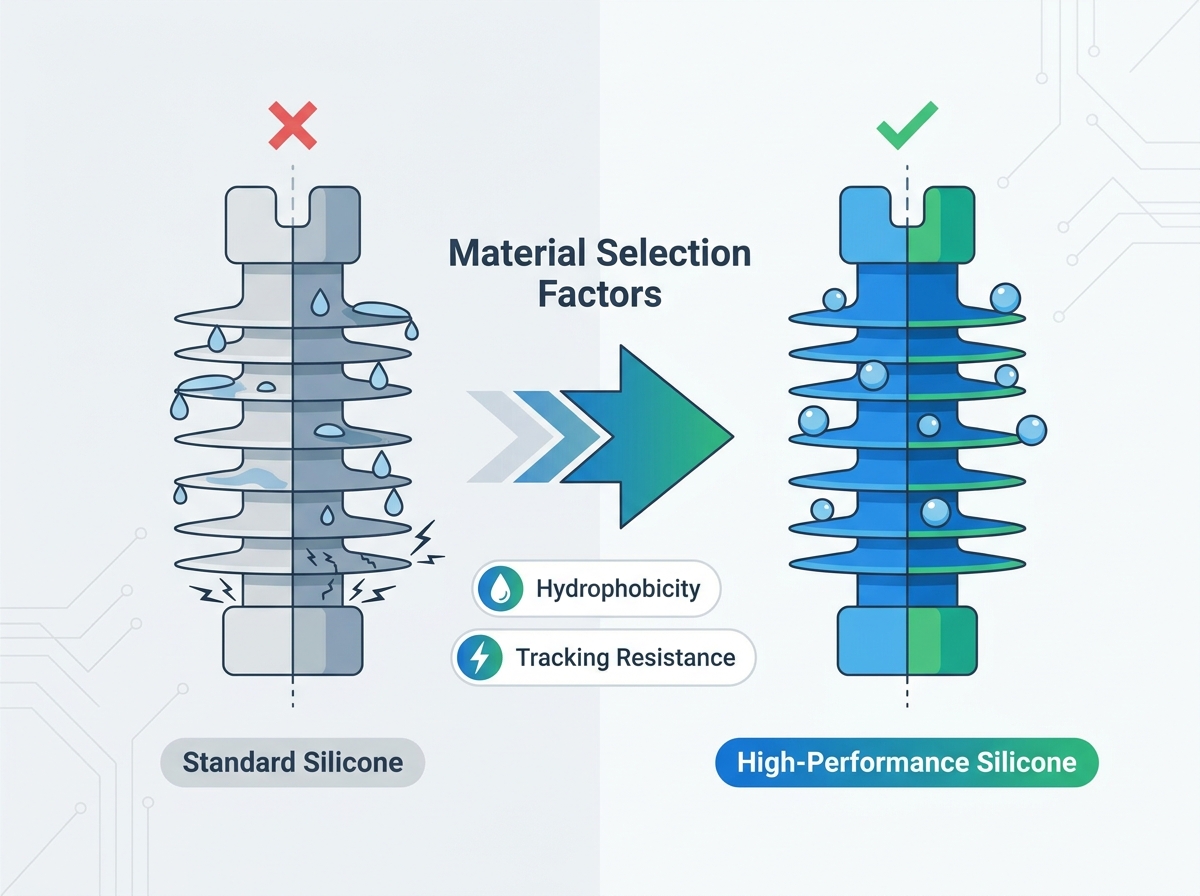
Evaluating silicone rubber for high-voltage applications requires looking beyond basic material data sheets. The polymer must meet stringent international standards designed to simulate decades of harsh environmental exposure. Field engineers rely on specific testing protocols to validate material performance before installation.
Hydrophobicity prevents the formation of continuous conductive water paths on the insulator surface. The mechanism relies on low molecular weight (LMW) siloxanes inherent in the polymer matrix. These highly mobile chains continuously migrate from the bulk of the material to the surface. When dirt, salt, or industrial pollution lands on the insulator, the LMW siloxanes physically encapsulate the particles.
Engineers evaluate this property using the IEC 62073 standard, which classifies hydrophobicity from HC1 to HC7. A critical secondary metric is the recovery rate. Severe corona discharge or heavy arcing temporarily destroys surface hydrophobicity, turning the surface hydrophilic. The silicone formulation must demonstrate the ability to rapidly migrate new LMW siloxanes to the surface to restore an HC1 or HC2 classification within 24 to 48 hours.
IEC 62073 Class | Surface Behavior Description | Field Performance Indicator |
|---|---|---|
HC 1 | Discrete, highly rounded water droplets. High contact angle. | Excellent. Optimal state for new or fully recovered silicone. |
HC 2 - HC 3 | Slightly less rounded droplets, some minor pooling. | Good. Typical operational state in moderately polluted areas. |
HC 4 - HC 5 | Mixed droplets and larger wet patches. | Marginal. Indicates recent corona exposure or heavy contamination. |
HC 6 - HC 7 | Continuous water film covering the entire surface. | Failure risk. High probability of leakage current and dry-band arcing. |
The primary function of the housing is electrical insulation. Dielectric strength measures the material's ability to withstand high voltage fields without suffering electrical breakdown or puncturing. Post insulators require exceptionally high dielectric strength (typically >20 kV/mm) to manage the intense electrical stress concentrated near the metal end fittings.
Volume resistivity and the dissipation factor (loss tangent) are equally critical. High volume resistivity (often >10^14 ohm-cm) prevents current from flowing through the bulk of the material. A low dissipation factor ensures that minimal electrical energy converts into heat within the polymer housing under alternating current (AC) loads. Excessive heat generation accelerates polymer degradation and leads to premature failure.
In heavily polluted and wet conditions, small leakage currents inevitably develop. These currents heat the moisture on the surface, causing it to evaporate and form dry bands. The voltage jumps across these dry bands, creating intense electrical arcs. This dry-band arcing generates extreme localized heat that degrades the polymer, leaving behind conductive carbon tracks. Once a carbon track connects the two end fittings, a complete flashover occurs.
Silicone formulations combat this threat through optimized filler loading. Alumina Trihydrate (ATH) is the standard solution. When exposed to the heat of an electrical arc (around 220°C), ATH undergoes an endothermic reaction. It decomposes and releases water vapor. This vapor actively quenches the electrical arc and cools the material surface, preventing carbon formation.
Materials must pass the inclined plane test outlined in IEC 60587. During this rigorous test, a liquid contaminant flows over the silicone sample while a high voltage is applied. Premium insulator materials must withstand specified voltage levels, such as 4.5 kV, for a continuous 6-hour period without tracking or eroding beyond acceptable limits.
While the FRP core provides the primary structural strength, the silicone housing must withstand significant physical abuse. High tear strength (measured via ASTM D624) and tensile strength are essential for preventing damage to the delicate weather sheds during transport, rough installation procedures, and high-wind events. A torn shed alters the creepage distance and creates a collection point for moisture and dirt.
Elongation at break is crucial for operational longevity. Post insulators bend under heavy cantilever loads. The silicone housing must stretch and flex in perfect unison with the internal FRP core. If the elastomer is too brittle, the cantilever stress will cause micro-cracking at the shed roots or catastrophic delamination from the core.
Silicone plays a dual role as an electrical and thermal insulator. High-voltage hardware generates heat. Silicone's low thermal conductivity prevents this localized heat from spreading rapidly through the housing. This thermal management prevents thermal runaway scenarios that could damage the sensitive epoxy matrix of the internal FRP core.
Environmental stress factors relentlessly attack the polymer. The formulation must resist intense UV degradation, ozone exposure, and extreme temperature cycling ranging from -50°C to +50°C. Engineers validate this resilience using accelerated aging protocols. The IEC 62217 standard requires materials to undergo 1000-hour or 5000-hour multi-stress aging tests inside specialized weather chambers. These tests combine UV radiation, salt fog, rain, and continuous voltage to simulate decades of field exposure.
A single silicone formulation cannot optimally serve every global environment. Engineers must align the material specifications with the specific geographic and operational realities of the installation site. Specifying the wrong compound leads to rapid degradation and unexpected outages.
Substations located near coastlines face continuous salt fog exposure. Industrial zones bombard insulators with sulfur dioxide, cement dust, and metallic particles. In these severe environments, maximum hydrophobic transfer is the highest priority. The material must rapidly encapsulate heavy pollution layers. These locations require the highest possible ATH loading to combat the inevitable increase in dry-band arcing caused by the conductive contaminants. HTV formulations are almost exclusively used in these scenarios due to their high filler capacity.
Installations in arctic or mountainous regions demand formulations optimized for low-temperature flexibility. Standard elastomers become rigid and brittle at sub-zero temperatures, leading to fracture under wind or ice loads. Specialized phenyl-modified silicone compounds maintain their elasticity well below -50°C. High-altitude applications expose the insulators to significantly higher levels of solar UV radiation. The material requires enhanced UV stabilizers to prevent surface chalking and crazing over its service life.
The electrical stress gradients vary massively between medium voltage (MV), high voltage (HV), and ultra-high voltage (UHV) systems. MV applications often prioritize manufacturing efficiency and dimensional precision, making LSR an excellent fit. UHV systems, operating at 800kV or higher, generate intense corona discharges and massive electrical fields. These applications demand the absolute highest tracking resistance and dielectric strength, requiring heavily filled HTV formulations.
Specifying a high-quality silicone rubber is only the first step. The actual manufacturing process introduces significant variables that can compromise the final post insulator. Factory floor execution is just as critical as polymer chemistry.
The interface between the silicone housing and the FRP core is the most critical vulnerability in a composite insulator. If the chemical bond fails, micro-voids form along the interface. Moisture eventually penetrates these voids, leading to internal electrical tracking. This internal tracking rapidly destroys the FRP core, resulting in catastrophic brittle fracture and structural collapse.
Mitigating this risk requires rigorous process control during manufacturing. The standard procedure involves several strict steps:
Thoroughly cleaning and degreasing the FRP core to remove all machining oils and dust.
Applying a specialized silane primer to the core surface to act as a chemical bridge.
Baking the primed core to flash off solvents and activate the coupling agents.
Injecting or compressing the silicone under high pressure to evacuate all trapped air.
Advanced quality control programs utilize acoustic emission testing or ultrasonic scanning to verify the integrity of the interface non-destructively before the insulator leaves the factory.
Material rheology must match the mold design. Selecting a highly viscous HTV formulation for a complex post insulator with deep, narrow sheds can cause severe flow issues. The material may not reach the extremities of the mold before vulcanization begins. This premature curing results in short shots, voids, and weak knit lines.
Engineers must collaborate closely with material formulators. They must balance the required filler content with the flow characteristics needed for the specific injection or compression mold. Adjusting mold temperatures, injection pressures, and venting locations is essential to accommodate the chosen silicone compound.
Inconsistent material compounding leads to localized weak points. If the peroxide or platinum catalyst is not distributed evenly, certain areas of the housing will remain under-cured and mechanically weak. Poor filler dispersion leaves sections of the insulator without adequate ATH protection, creating vulnerable spots for electrical tracking.
Mitigating batch inconsistency requires mandating strict ISO 9001 quality documentation from the material supplier. Manufacturers must perform routine incoming material inspections. Utilizing moving die rheometers (MDR) verifies the curing kinetics of each batch. Specific gravity checks ensure the filler loading remains consistent before the material ever enters the molding machine.
Request comprehensive technical data sheets (TDS) from material suppliers to verify baseline mechanical and dielectric properties against your project specifications.
Demand independent laboratory test reports confirming compliance with IEC 60587 for tracking resistance and IEC 62217 for multi-stress aging.
Conduct extensive trial molding runs to validate the chemical adhesion between the selected silicone and the specific FRP core material using your existing factory equipment.
Contact us to audit the supplier's mixing facility and ensure they utilize moving die rheometers (MDR) for strict batch-to-batch consistency.
A: HTV (High-Temperature Vulcanized) rubber is a high-viscosity material ideal for heavy filler loading and ultra-high voltage applications. LSR (Liquid Silicone Rubber) is a two-part, platinum-cured liquid system processed via injection molding. LSR offers faster cycle times and precise dimensions, while HTV provides superior mechanical toughness and higher tracking resistance.
A: Silicone rubber inherently recovers and transfers its hydrophobicity to accumulated surface pollution. This unique trait prevents continuous water films from forming, drastically reducing leakage currents and dry-band arcing. EPDM lacks this hydrophobic transfer capability, making it highly susceptible to tracking and flashovers in contaminated environments.
A: ATH is a critical filler that improves tracking and erosion resistance. When exposed to the intense heat of dry-band arcing, ATH decomposes and releases water vapor. This endothermic reaction cools the material surface and actively quenches the electrical arc, preventing carbon tracking and premature degradation.
A: The polymer network contains low molecular weight (LMW) siloxanes. These highly mobile molecules continuously migrate from the bulk material to the surface. They physically encapsulate dirt, salt, and industrial pollutants, ensuring the surface remains highly water-repellent even under heavy, continuous contamination.
A: Silicone acts as an effective thermal barrier. High electrical stress near metal end fittings generates localized heat. The thermal insulation properties prevent this heat from spreading rapidly through the housing, mitigating the risk of thermal runaway and protecting the internal fiberglass core from thermal degradation.
A: Key standards include IEC 60587 for evaluating resistance to tracking and erosion under severe ambient conditions. IEC 62073 classifies the material's hydrophobicity and recovery rate. IEC 62217 outlines multi-stress accelerated aging tests to ensure long-term weathering and dielectric stability.


