

Views: 0 Author: Site Editor Publish Time: 2026-10-14 Origin: Site


Engineers and procurement teams face a critical commercial decision when specifying silicone materials. You must constantly balance strict mechanical performance requirements alongside tight unit economics. Choosing the right base polymer ultimately dictates your product's commercial viability in competitive markets. Specifying fumed silicone for a basic, general-purpose part quickly destroys profit margins. Conversely, using a precipitated silicone rubber compound for high-stress or medical applications introduces severe field risks. Product failure and compliance breaches become real threats if you select an inadequate compound.
This material choice impacts every single stage of production. From injection molding cycle times to end-user safety, the stakes remain remarkably high. We provide a transparent, evidence-based evaluation framework below. You will learn how to align material properties—driven by their respective silica fillers—with specific manufacturing outcomes. We will help you satisfy complex regulatory requirements and hit budget constraints efficiently, ensuring a highly successful product launch.
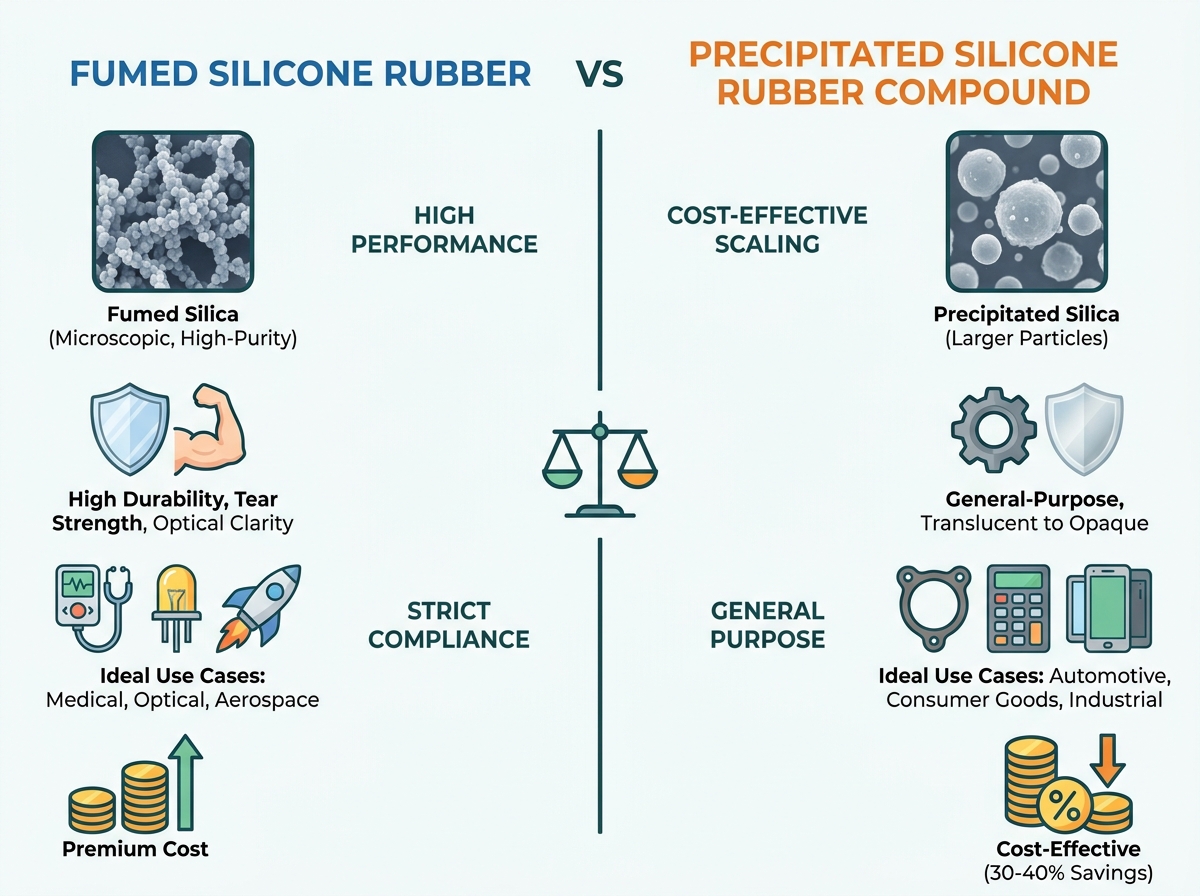
The difference lies in the reinforcement filler: fumed silica creates a highly durable, transparent material, while precipitated silica offers a cost-effective, general-purpose alternative.
Fumed silicone rubber is the standard for optical clarity, high tear strength, and strict regulatory compliance (FDA/Medical-grade).
Precipitated silicone rubber compound delivers up to 30-40% cost savings for high-volume manufacturing where extreme tensile strength and high transparency are not critical.
Material selection should be driven by a rigid features-to-outcomes matrix rather than defaulting to the highest specification.
Uncured "raw" silicone polymer resembles a weak, gummy paste. It completely lacks the structural integrity necessary for any demanding commercial use. We must add reinforcing silica fillers to achieve functional durability. The type of silica introduced during compounding dictates the final physical characteristics of the rubber.
Manufacturers create fumed silica using a sophisticated vapor-phase hydrolysis process. High-temperature flame hydrolysis of silicon tetrachloride produces microscopic, exceptionally pure silica structures. These ultra-fine particles boast an enormous surface area. They bind tightly into the siloxane polymer matrix. This tightly integrated network results in superior physical properties, preventing crack propagation under stress.
Precipitated silica relies on a wet-chemical precipitation process instead. Sodium silicate solutions react under precisely controlled acidic conditions to precipitate silica out of the liquid. This methodology produces larger, slightly less pure particles compared to vapor-phase versions. It yields a highly functional compound, but the internal polymer network remains less rigorously structured.
Silica manufacturing complexity dictates your final material price. Higher purity vapor-phase processes consume immense energy and require expensive equipment. Consequently, the filler type directly dictates the financial scalability of your silicone components. You pay a premium for atomic-level purity and extreme reinforcement.
When engineering critical components, fumed silicone rubber stands as the premier choice. The tightly bound silica matrix delivers exceptional reliability under punishing field conditions.
These compounds deliver distinct advantages across core mechanical metrics. You will observe significantly higher tensile strength and tear resistance compared to standard alternatives. Elongation characteristics also remain incredibly robust under repeated cyclic loading. Engineers rely heavily on these specific properties for dynamic seals, pump diaphragms, and industrial belting.
You can achieve near-perfect transparency using these advanced formulations. The microscopic size of the filler particles allows visible light to pass through easily without scattering. This optical clarity proves essential for LED lenses, clear fluid tubing, and premium consumer aesthetics. The material resists clouding even after extended environmental exposure.
Medical and food-contact sectors maintain strict purity thresholds. Class II and Class III medical devices require ultra-low impurity levels to ensure absolute biocompatibility. Manufacturers heavily specify fumed compounds here because they avoid harmful leaching. They also resist yellowing during autoclave sterilization cycles. Premium food-contact products and aerospace components demand this exact baseline stability.
This unmatched performance commands a notable premium price point. You should justify the extra raw material expense carefully during the design phase. We recommend specifying these high-grade polymers only when failure risks or strict compliance mandates require them.
Always verify USP Class VI or ISO 10993 certifications before approving medical materials.
Specify platinum-cured fumed compounds to completely eliminate peroxide byproducts.
Request batch-specific testing data to ensure consistent tear strength across shipments.
Procurement teams often misunderstand standard commercial grades. You should frame precipitated silicone rubber compound not as "inferior," but as practically engineered. They perfectly suit the vast majority of consumer and industrial manufacturing applications.
These materials meet rigorous industry standards without over-delivering on unnecessary metrics. They provide excellent thermal stability, strong electrical insulation, and reliable weatherability. For static applications experiencing minimal dynamic stress, they perform flawlessly over decades.
You must set realistic expectations regarding material appearance. Parts molded from these compounds typically look translucent or fully opaque. They may also show slight yellowing over extended multi-year periods. If visual perfection remains secondary to function, this aesthetic compromise rarely impacts utility.
Manufacturers deploy them widely across incredibly diverse industries. Common applications include automotive gaskets, membrane keypad domes, and kitchen baking mats. You will also find them frequently in standard O-rings, wire insulation, and durable consumer electronics casings.
High-volume production runs heavily favor these specific materials. Transitioning to a standard compound can drastically reduce your bill-of-materials (BOM) costs. For production volumes exceeding 100,000 units, these savings multiply rapidly. You capture massive financial efficiencies without sacrificing functional viability.
Do not specify these materials for components requiring high light transmission.
Avoid using them in dynamic, high-flex environments where tear propagation is a risk.
Never assume standard grades meet stringent pharmaceutical compliance without testing.
Comparing fumed vs precipitated silicone rubber requires a systematic approach. You must evaluate multiple intersecting variables to make an informed procurement choice.
Table 1: Silica Filler Comparison Matrix
Evaluation Criteria | Fumed Compounds | Precipitated Compounds |
|---|---|---|
Filler Particle Size | Microscopic (High Surface Area) | Larger (Lower Surface Area) |
Visual Clarity | High Transparency | Translucent to Opaque |
Tear Strength | Exceptional | Moderate to Good |
Primary Markets | Medical, Aerospace, Optical | Automotive, Consumer Goods |
Cost Profile | Premium Pricing | Economical / Budget-Friendly |
Avoid over-engineering your components. Build a rigid framework to identify when standard materials are "good enough." High-purity varieties become absolutely non-negotiable for optical lenses or implantable tubing. Standard industrial environments, however, tolerate lower tear strengths perfectly well. Align your material properties strictly with intended field use.
Compare raw material expenses directly on your balance sheet. The sophisticated processing required for vapor-phase silica elevates base costs significantly. These premiums compound dramatically at industrial scales. Standard materials allow you to scale consumer products aggressively while maintaining healthy profit margins.
Address actual implementation realities on your factory floor. The two variants exhibit notable differences in mold shrinkage rates. They also demand slight adjustments in vulcanization curing times. Furthermore, pigment mixing behaves differently; standard materials often require more pigment volume to achieve vibrant, opaque colors.
Evaluate degradation timelines comprehensively over a 5-to-10-year product lifecycle. Both withstand extreme temperatures, UV exposure, and ozone well. However, high-purity compounds maintain their original physical properties slightly longer under continuous dynamic stress. They resist compression set better in demanding sealing applications.
Switching polymers mid-production introduces substantial engineering risks. You must manage tooling and validation processes meticulously to prevent costly manufacturing delays.
You must carefully address whether existing molds remain fully compatible. Repurposing injection tools designed for one material can cause severe dimensional issues. You must account for the specific variance in shrinkage rates between the two filler types. Failing to adjust mold dimensions results in rejected parts and compromised sealing tolerances.
We strongly recommend a phased, deliberate rollout approach.
Begin by prototyping with both material variants simultaneously.
Conduct accelerated aging tests in simulated environmental chambers.
Verify actual tear strength performance during real-world assembly processes.
Run a pilot manufacturing batch to confirm acceptable cycle times.
Always evaluate your global material availability. High-purity silica occasionally faces localized shortages due to complex manufacturing constraints. Standard precipitated compounds typically boast a wider, highly diversified supplier base. This broader global availability can effectively mitigate raw material bottlenecks during unexpected supply chain disruptions.
Neither material holds a universally superior status across all engineering disciplines. The right choice remains strictly application-dependent. You must analyze your exact mechanical needs before writing the specification. Choose high-purity fumed variants for optical clarity, high-stress durability, and strict medical compliance. Conversely, choose standard precipitated options for opaque, general-purpose components. Cost optimization firmly drives the latter decision in high-volume markets.
Take immediate action to validate your next material selection. Request comprehensive technical data sheets (TDS) from your trusted supplier today. Order sample plaques to conduct internal mechanical testing and fatigue analysis. Finally, consult directly with your injection molder regarding specific part geometries to ensure optimal manufacturability.
A: Yes, material scientists frequently blend them to balance cost and performance. Custom compounding allows manufacturers to hit specific tear strength targets while keeping material expenses manageable. You should rely on an experienced compounder to ensure homogeneous dispersion and consistent curing behavior across hybrid batches.
A: Yes, it can meet FDA (CFR 177.2600) compliance realities easily. However, manufacturers generally prefer higher purity alternatives for critical food-contact items. Standard fillers can occasionally introduce trace impurities, leading to potential off-tastes or regulatory friction during highly stringent facility audits.
A: Both filler types find extensive use in High Consistency Rubber (HCR). Liquid silicone rubber (LSR), however, heavily relies on treated fumed silica. The microscopic particle size is absolutely necessary to maintain the precise flow characteristics required for the LSR injection molding process.
A: You can typically expect a 20% to 50% price variance per kilogram. Exact pricing depends heavily on global silicone commodity markets, regional supply chains, and your specific custom formulations. Always request customized vendor quotes based on your exact mechanical and regulatory requirements.


