

Views: 0 Author: Site Editor Publish Time: 2026-11-13 Origin: Site


Housing degradation poses a silent but severe threat to modern power grids. When insulator housings fail, they allow moisture to penetrate sensitive internal components. This moisture ingress triggers thermal runaway. Ultimately, it leads to catastrophic arrester failure. Grid operators and facility managers are rapidly moving away from traditional porcelain. They now standardize on advanced polymeric materials. They specifically prioritize silicone formulations for new installations. Porcelain is simply too fragile and heavy. It also performs poorly in highly polluted environments.
This guide provides an objective, engineering-focused checklist. You will learn how to evaluate and procure reliable silicone materials. We will cover critical metrics, compliance standards, and essential vendor evaluation strategies. Following these steps helps you minimize lifecycle maintenance. You will also avoid substandard formulations that compromise system stability and safety.
Material formulation dictates lifespan: Not all silicone is equal; High-Temperature Vulcanized (HTV) and Liquid Silicone Rubber (LSR) serve different operational stresses.
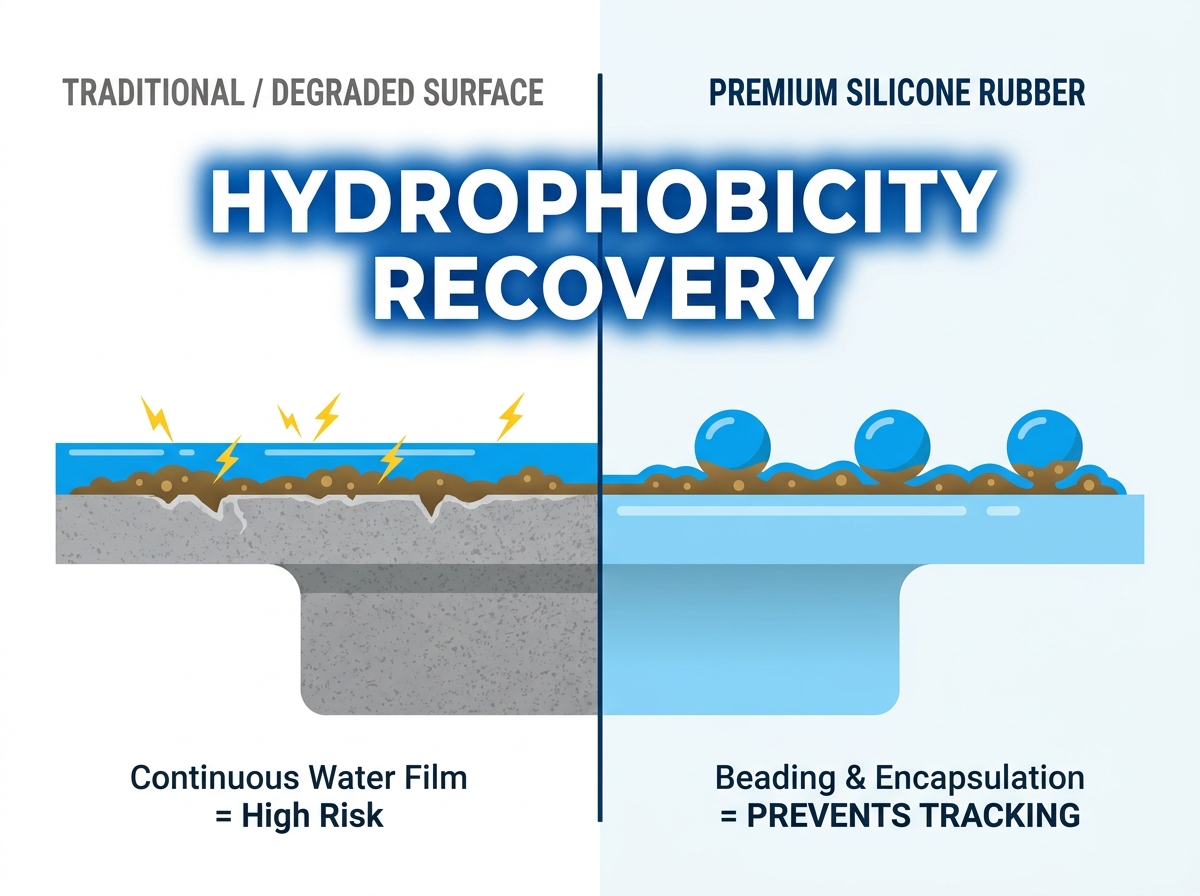
Hydrophobicity recovery is the critical metric: The ability of an insulator silicone rubber housing to transfer water-repellent properties to surface pollution is the primary defense against dry-band arcing.
Compliance is non-negotiable: Viable shortlists must provide third-party validation for IEC 60099-4 / IEEE C62.11 standards, specifically regarding tracking and erosion resistance.
The utility sector is undergoing a massive material transition. Operators are actively replacing legacy porcelain equipment. Traditional porcelain presents several operational challenges. It is extremely heavy. This excess weight complicates transport and requires robust supporting infrastructure. Porcelain is also highly fragile. It is susceptible to damage during transit, installation, and seismic events. In highly polluted environments, porcelain surfaces easily collect conductive contaminants. This buildup inevitably requires frequent washing to prevent flashovers.
Conversely, a modern silicone rubber surge arrester solves these legacy issues. Polymeric designs drastically reduce physical weight. They eliminate fragility concerns entirely. Most importantly, they excel in heavy pollution zones. They offer self-cleaning properties through natural hydrophobicity.
You must understand why arresters fail to select the right housing. Moisture ingress remains the undisputed leading cause of arrester failure. In traditional designs, thermal cycling breaks down the sealing gaskets over time. Once seals degrade, humidity enters the internal chamber. This moisture condenses on the zinc oxide blocks. It creates conductive pathways. Thermal runaway follows shortly after.
Modern silicone injection molding tackles this problem directly. High-quality manufacturers mold the polymer directly onto the internal core. This seamless construction eliminates air gaps. It removes the vulnerable gasket interfaces entirely. By evaluating the molding process carefully, you prevent the primary failure mode before installation.
A successful procurement rollout requires clear performance baselines. You should define success using measurable operational outcomes. First, you need zero catastrophic shatter failures. Polymeric materials tear rather than explode during severe faults. Second, you must achieve extended maintenance intervals. A successful rollout means zero routine washing requirements, even in heavy pollution zones. Finally, you want predictable lifecycle performance. Your chosen material must withstand decades of UV exposure without hardening or cracking.
Specifying a reliable insulator silicone rubber housing requires deep technical evaluation. You cannot simply accept "silicone" as a sufficient material description. You must evaluate the specific chemical properties and formulation techniques.
Hydrophobicity refers to how the material repels water. You measure this via the contact angle of water droplets. A high-quality silicone surface causes water to bead up into isolated drops. It prevents the formation of continuous, conductive water films. You should look for initial contact angle measurements exceeding 90 degrees.
However, initial water repulsion is not enough. You must assess the Hydrophobicity Transfer Material (HTM) property. In the real world, pollution layers coat the insulator. Salt, dust, and industrial fallout accumulate rapidly. Premium silicone contains low molecular weight (LMW) siloxanes. These siloxanes migrate through the pollution layer. They encapsulate the dirt particles. This action restores surface electrical resistance dynamically. You must ask vendors how quickly their formulation recovers its HTM properties after severe wetting.
Insulators face constant electrical stress under continuous operating voltage (COV). When pollution gets wet, small leakage currents flow across the surface. This current creates heat, drying out narrow bands of moisture. High electrical stress across these dry bands causes arcing. Dry-band arcing degrades poor-quality polymers quickly.
To combat this, manufacturers add Alumina Trihydrate (ATH) fillers to the silicone matrix. When dry-band arcs heat the surface, ATH releases water vapor. This endothermic reaction cools the arc and suppresses carbon tracking. Your required baseline is strict. The material must pass the 1000-hour salt-fog tracking and erosion test. Never accept materials lacking this specific validation.
Manufacturers generally use two primary types of silicone for electrical housings. You must choose the right formulation based on your application demands.
High-Temperature Vulcanized (HTV): HTV offers exceptional mechanical strength. It handles heavy pollution exceptionally well. Manufacturers typically use HTV for distribution and transmission class arresters. It features a high filler capacity, allowing for heavy ATH loading.
Liquid Silicone Rubber (LSR): LSR provides superior injection molding precision. It allows for faster production cycles. LSR is ideal for creating complex shed profiles. Engineers often select it for lower-voltage applications or highly detailed geometries.
HTV vs. LSR Material Comparison
Property | High-Temperature Vulcanized (HTV) | Liquid Silicone Rubber (LSR) |
|---|---|---|
Mechanical Strength | Very High | Moderate to High |
ATH Filler Capacity | Excellent (High loading possible) | Good (Limited by viscosity) |
Production Speed | Slower (Compression/Injection) | Fast (Automated Liquid Injection) |
Ideal Application | Transmission lines, high pollution | Distribution lines, complex sheds |
Procurement teams must demand rigorous documentation. You cannot rely on marketing claims. Independent laboratory testing guarantees material reliability.
These two frameworks form the global foundation for arrester reliability. You must review the manufacturer's type test reports carefully. Look for successful operating duty tests. Verify the short-circuit testing results. The reports must confirm the housing did not catch fire or shatter during deliberate internal fault testing. Ensure accredited third-party labs issued these reports.
Outdoor substations subject polymers to brutal environmental conditions. Solar radiation breaks down weak chemical bonds. You must verify ASTM G154 or equivalent accelerated aging test data. Proper testing ensures the silicone rubber for lightning arresters maintains its integrity. High-quality compounds will not chalk, crack, or harden under intense UV exposure. Demand data showing performance after 1,000 to 5,000 hours of simulated weathering.
The boundary between the outer polymer and internal components is critical. You must examine the bonding method. How does the vendor attach the silicone to the internal fiberglass reinforced polymer (FRP) core? How do they protect the Metal Oxide Varistor (MOV) blocks?
Request thermal cycling data: Extreme temperature shifts cause materials to expand and contract at different rates.
Verify the chemical primer: Ensure they use high-grade coupling agents for chemical bonding, not just physical friction.
Check moisture ingress tests: Review the boiling water immersion test results to confirm seal permanence.
Real-world environments demand customized solutions. A generic specification often fails in harsh localized climates. You must tailor your selection criteria to the installation site.
The physical shape of the housing matters immensely. You must match the alternating shed design and creepage distance to the specific site pollution severity (SPS) class. The IEC 60815 standard provides guidelines for this. For light pollution, standard alternating sheds work fine. For very heavy pollution, you need extended creepage distances. You also need wider spacing between sheds. This spacing prevents heavy rain from creating continuous conductive water bridges down the arrester.
Salt fog and industrial chemicals aggressively attack polymers. If you operate in coastal or heavy industrial zones, adjust your evaluation criteria. These extreme environments require higher ATH filler content. The salt spray constantly challenges the hydrophobicity transfer mechanism. Ask vendors for specific case studies from marine environments. Verify their ATH loading percentage by weight.
Silicone handles explosive failure safely. In an internal short circuit, pressure vents through the flexible polymer housing. The housing tears, eliminating the dangerous, high-velocity shrapnel associated with porcelain. However, silicone itself provides no structural support. You must evaluate the cantilever strength of the underlying FRP core. During installation planning, ensure the FRP tube can handle wind loads, seismic activity, and terminal connector strain.
Vendor selection requires deep supply chain scrutiny. The best design fails if manufacturing quality control is poor.
Traceability of Raw Materials: Does the vendor compound their own silicone or purchase pre-mixed polymers? Ask for supply chain transparency. In-house compounding often indicates tighter quality control. Verify their raw polymer sources.
Quality Assurance in Molding: Evaluate the vendor’s void-detection processes. Ask if they use X-ray inspection or routine partial discharge testing. You must ensure no microscopic air gaps exist between the silicone and the core. Air gaps eventually cause internal arcing.
Proof of Historical Performance: Do not be a testing ground for unproven manufacturers. Request field-data reports. Ask for reference lists of deployments surviving 10+ years. Ensure these historical deployments match your specific environmental conditions.
Selecting the right polymer housing is a critical engineering decision. Simply specifying "silicone" is insufficient for grid reliability. You must specify the exact formulation, the ATH filler content, and the required tracking resistance. Substandard materials will fail silently, leading to catastrophic system outages down the line.
Moving forward, take immediate action to secure your supply chain. Request sample material data sheets from your current vendors. Demand certified independent lab reports from recognized authorities like KEMA or CESI. Finally, initiate a limited pilot installation for high-risk, heavy-pollution substations. Monitor these pilot units closely before committing to a full network rollout.
A: Typically 15 to 25+ years. This lifespan is highly dependent on UV exposure, pollution severity, and the quality of the ATH fillers. Premium fillers prevent surface erosion and extend operational life significantly in harsh environments.
A: No. Unlike porcelain or EPDM, premium silicone is self-cleaning. It utilizes active hydrophobic recovery to encapsulate dirt and repel water. This mechanism maintains surface electrical resistance even in heavily polluted areas without manual washing.
A: In the event of an internal short circuit, gas pressure builds rapidly. This pressure vents directly through the flexible polymer housing. The material tears safely rather than shattering into dangerous, high-velocity shrapnel like traditional porcelain.
A: Yes. Low-quality formulations without adequate UV stabilizers or proper filler dispersion will degrade. They often experience "chalking" or hardening over time. This highlights why verifying accelerated aging test reports is critical during procurement.


