

Views: 0 Author: Site Editor Publish Time: 2026-09-11 Origin: Site


High-voltage transmission networks operate in brutal environments. You have severe pollution, constant moisture, and relentless UV exposure attacking the infrastructure daily. Traditional ceramic and glass insulators are heavy, brittle, and a nightmare to maintain. Worse, they fail to suppress leakage currents when covered in grime, leading to flashovers, unplanned outages, and endless washing cycles. Composite post insulators solve these problems, but their field reliability depends entirely on the external housing. If the housing fails, the core fails. This guide breaks down the technical specifications, aging characteristics, and procurement criteria for silicone rubber sheds for insulators. We will look at material formulations, shed profiles, and field-tested installation practices to keep your grid stable and reduce maintenance overhead.
Hydrophobicity Transfer is Critical: The primary advantage of silicone rubber sheds is their ability to transfer water-repellent properties to surface pollution layers, drastically reducing leakage currents and flashover risks.
Material Formulation Dictates Lifespan: High-Temperature Vulcanized (HTV) silicone rubber heavily doped with Alumina Trihydrate (ATH) is required to achieve necessary tracking and erosion resistance.
Aging Diagnostics are Essential: Long-term environmental exposure causes physical and chemical degradation; evaluating manufacturers requires understanding their testing protocols for decay-like fractures and material aging (e.g., FTIR, NMR).
Profile Design Impacts Performance: Selecting the correct shed profile (alternating vs. uniform) and calculating accurate creepage distances based on specific site pollution severity is mandatory for compliance and performance.
Composite insulators rely on a strict division of labor between their components. The core consists of a fiberglass reinforced polymer (FRP) rod. This rod takes on the mechanical load, providing the necessary tensile and bending strength to hold the conductors. Metal end fittings crimp onto this rod to transfer those mechanical loads to the supporting towers. Surrounding this core is the polymeric housing, which field engineers often call the umbrella skirt sheath. The core handles the physical stress, while the sheds exclusively manage environmental protection and electrical insulation. They block moisture from reaching the FRP core and provide the surface distance required to stop electrical tracking. If the housing degrades or tears, moisture enters, and the entire insulator assembly will eventually fail.
When specifying housings, you generally choose between two primary silicone materials. High-Temperature Vulcanized (HTV) silicone rubber uses high molecular weight polymers. Liquid Silicone Rubber (LSR) relies on shorter polymer chains. The manufacturing processes dictate their final physical properties. HTV requires high-pressure extrusion or injection molding at elevated temperatures. LSR involves pumping liquid components into a heated mold for rapid curing.
For high-voltage outdoor applications, HTV silicone rubber dominates the market. It delivers superior mechanical durability, exceptional tear strength, and a high cross-linking density that withstands severe environmental stress. This dense molecular structure gives synthetic insulators their excellent electrical properties. While LSR offers faster production times for manufacturers, HTV remains the standard for long-term reliability in extreme environments.
Property | HTV Silicone Rubber | Liquid Silicone Rubber (LSR) |
|---|---|---|
Molecular Weight | High | Low to Medium |
Manufacturing Process | High-pressure extrusion / injection molding | Liquid injection molding |
Tear Strength | Excellent (Highly resistant to field damage) | Moderate |
Cross-linking Density | Very High | Medium |
Primary Application | High-voltage outdoor insulators | Lower voltage or indoor applications |
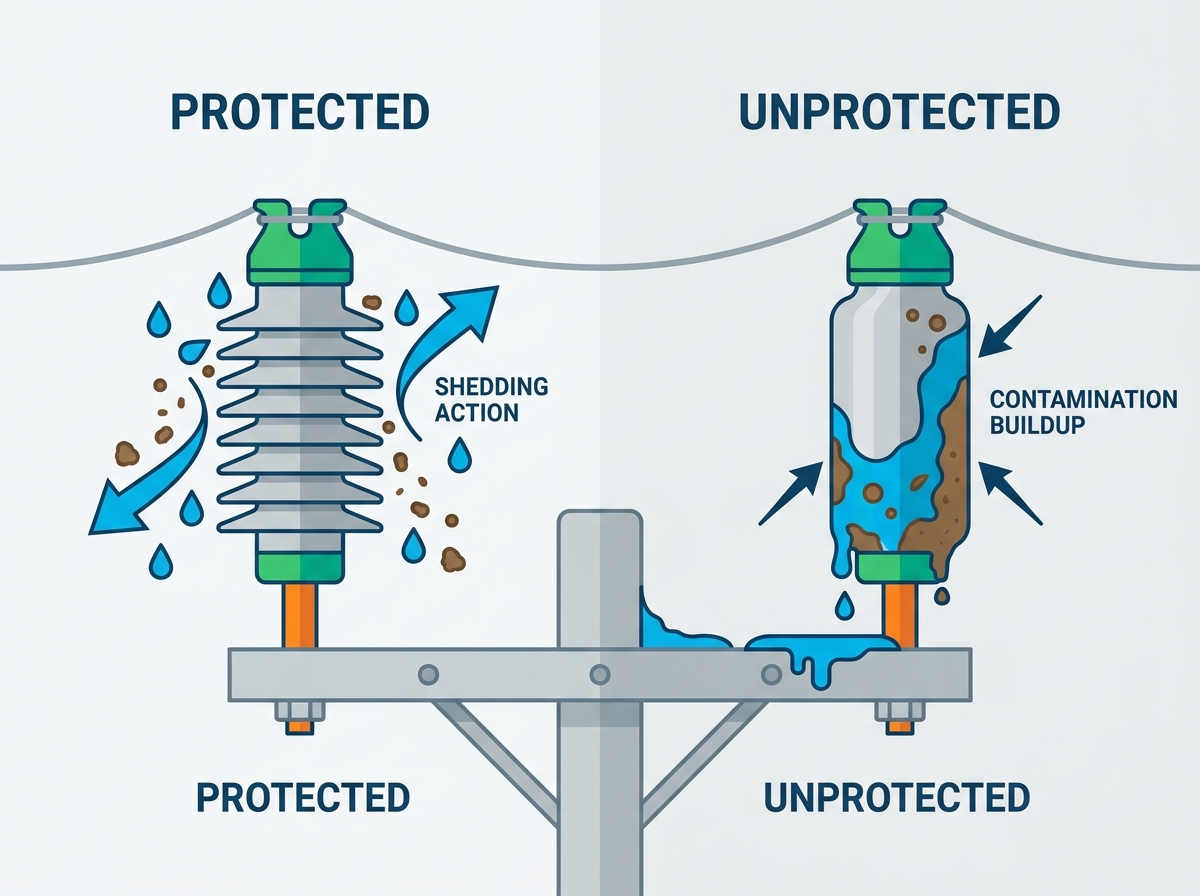
The physical geometry of the sheds dictates the electrical performance of the insulator. Sheds artificially extend the surface distance between the energized conductor and the grounded tower. We call this extended path the creepage distance. Adequate creepage stops leakage currents from crossing the insulator surface. The aerodynamic design of the sheds is equally important. Proper spacing prevents rainwater from bridging the gaps between individual sheds. If water bridges these gaps, it creates a continuous conductive path. This path leads directly to dry-band arcing and eventual electrical tracking. Well-designed sheds disrupt water flow, forcing moisture to drip off the edges rather than run down the core. This specific geometry maintains high dielectric strength even during torrential downpours.
Silicone rubber naturally repels water. Instead of forming a continuous conductive film, water beads up into isolated droplets on the surface. This hydrophobicity stops conductive paths dead in their tracks. But the real advantage of silicone rubber is its Hydrophobicity Transfer Material (HTM) characteristic. The bulk rubber matrix contains low molecular weight (LMW) siloxanes. Over time, these LMW siloxanes continuously migrate from the inside of the material to the surface.
When wind blows dirt, salt, or industrial exhaust onto the insulator, these siloxanes encapsulate the pollution particles. This encapsulation transfers the water-repellent properties directly to the pollution layer itself. The surface remains hydrophobic even when heavily contaminated with coastal salt fog or desert dust. This mechanism slashes leakage currents and eliminates the continuous water films that cause flashovers.
High-voltage environments subject insulators to relentless electrical stress. Dry-band arcing generates intense, localized heat on the insulator surface, which can quickly degrade standard polymers. To stop this, manufacturers dope the silicone formulation with Alumina Trihydrate (ATH) fillers. ATH acts as a built-in flame retardant and heat sink.
When exposed to the extreme temperatures of an electrical arc, ATH triggers an endothermic reaction. It releases water vapor, which immediately cools the surface and extinguishes the arc. This reaction suppresses localized heat and stops carbon tracking from forming. The housing provides excellent resistance to tracking over decades of continuous use. We evaluate this resistance using standard inclined plane tests, specifically the IEC 60587 standard. High-quality sheds must pass these rigorous voltage tracking tests without showing significant erosion or catching fire.
Traditional porcelain insulators are heavy and brittle. They crack under impact, and dropping one during installation usually means throwing it in the dumpster. Silicone rubber offers elastomeric properties that completely change how crews handle the equipment. This flexibility drastically reduces the risk of accidental damage during transport, rigging, and installation. Vandalism risks also drop, as silicone sheds simply bounce back when struck by rocks or debris, whereas porcelain shatters.
Furthermore, the lightweight and flexible nature of composite insulators improves performance in seismically active zones. They dampen mechanical vibrations rather than amplifying them. This reduces the mechanical load transferred to transmission towers during earthquakes, keeping the grid stable when natural disasters strike.
Composite insulators face decades of relentless environmental abuse. A typical lifecycle spans 20 to 30 years, and the materials must survive the entire duration. Continuous UV radiation bombards the surface, slowly breaking down polymer bonds. High-voltage fields generate ozone, which accelerates oxidation across the housing. Daily temperature cycling causes continuous expansion and contraction. This thermal stress constantly tests the adhesive interface between the FRP core and the silicone housing.
Additionally, corona discharges generate localized plasma that bombards the silicone surface with high-energy ions. Over time, these combined factors degrade the polymer matrix. The surface loses some of its hydrophobicity, and micro-cracks can develop if the manufacturer used a subpar material formulation. You must understand these degradation factors to evaluate the long-term reliability of any insulator you plan to deploy.
You cannot rely on visual inspections to verify material quality; you need hard data. Fourier Transform Infrared Spectroscopy (FTIR) is the primary diagnostic tool for this. FTIR analyzes the chemical bonds on the insulator surface by measuring the absorption of specific infrared wavelengths. As silicone ages, it loses methyl groups in the matrix. FTIR accurately quantifies this loss, giving you a clear picture of surface degradation.
Nuclear Magnetic Resonance (NMR) provides even deeper insights. NMR evaluates the molecular structure within the bulk material itself. It detects backbone chain scission within the umbrella skirt sheath, showing you if the material is breaking down internally. Together, FTIR and NMR provide a comprehensive aging profile. We also use physical property testing as a leading indicator of material fatigue. Technicians measure hardness increases and tensile strength reduction over time. If a batch shows significant physical changes during accelerated aging tests, it indicates severe polymer degradation and should be rejected.
Decay-like fractures are a catastrophic failure mode for composite insulators. This happens when moisture breaches the silicone housing and reaches the core. High electrical stress and corona discharge generate ozone. That ozone reacts with atmospheric nitrogen and the trapped moisture to form nitric acid. This acid pools inside the insulator housing and directly attacks the FRP core. The fiberglass rod degrades, loses its mechanical strength, and eventually snaps under normal tension loads.
The aging characteristics of the silicone rubber sheds directly influence this risk. If the sheath integrity is compromised, core failure accelerates rapidly. Mitigation requires strict manufacturing controls. You need seamless sheath extrusion to prevent longitudinal seams where moisture could enter. You need superior core-to-housing adhesion to eliminate internal voids where acid could pool. Finally, rigorous seal testing at the metal end fittings is required to ensure complete moisture exclusion.
The chemical formulation dictates how the insulator performs in the field. Your procurement specifications must establish strict baselines for acceptable ATH filler percentages. High-quality HTV silicone requires heavy ATH doping to survive electrical arcing. Optimal formulations contain significant ATH volumes to ensure the endothermic reaction works when needed.
You must watch out for manufacturers using cheap fillers. Silica or calcium carbonate reduce manufacturing costs, but they ruin performance. These inferior fillers do not release water vapor under heat. They fail to suppress carbon tracking and ultimately compromise the dielectric strength of the housing. Always request detailed material composition reports before approving a vendor. Verify the specific type and volume of fillers they use in their extrusion process.
The physical shape of the sheds must match the environment where you install them. Manufacturers offer standard, alternating, and under-ribbed shed profiles. Standard profiles feature uniformly spaced sheds of equal diameter. Alternating profiles use large and small sheds in sequence, which prevents heavy rain from cascading down the insulator and bridging the gaps. Under-ribbed profiles increase the creepage distance without extending the overall length of the insulator.
You must match the shed profile to the Site Pollution Severity (SPS) class of your installation area. Heavy desert dust requires open profiles so the wind can clean them. Coastal salt fog demands alternating profiles to break up water streams. Heavy industrial zones necessitate maximum creepage distances to handle chemical fallout.
Site Pollution Severity (SPS) | Environmental Conditions | Recommended Shed Profile |
|---|---|---|
Light to Medium | Rural areas, low industrial activity | Standard uniform profile |
Heavy | Coastal areas, moderate industrial pollution | Alternating profile (large/small) |
Very Heavy | Desert regions, heavy chemical/mining fallout | Alternating or under-ribbed with maximum creepage |
Procurement shortlisting requires mandatory certifications. International standards validate the quality and longevity of the silicone rubber housing, and you should never bypass them. IEC 61109 covers composite suspension and tension insulators. IEC 62217 details general definitions and test methods for polymeric insulators. IEEE C29.11 provides equivalent standards for the North American market.
These standards mandate specific, brutal tests. The 1000-hour tracking and erosion test validates the ATH filler performance. The boiling water test confirms the core-to-housing adhesion remains intact under thermal stress. The dye penetration test ensures the FRP core lacks internal voids. Demand certified test reports from independent, third-party laboratories. Never accept internal manufacturer testing as the sole proof of compliance.
Selecting high-quality HTV silicone rubber insulators fundamentally changes how you manage grid maintenance. Traditional porcelain requires routine washing in polluted environments. Washing crews have to mobilize specialized equipment, trucks, and de-ionized water. This process demands massive labor hours and complex operational planning to manage the outages.
High-quality silicone sheds eliminate the need for routine washing. The hydrophobicity transfer mechanism maintains dielectric strength automatically, encapsulating dirt as it lands. This self-cleaning property drastically reduces operational downtime and minimizes unplanned outage penalties. The grid operates with higher reliability during severe weather events, allowing your maintenance crews to focus on actual repairs rather than washing glass and ceramic.
Even the best silicone housing will fail if your crews destroy it during installation. Improper handling ruins the protective properties of the polymer matrix. Utility crews must follow strict implementation protocols to protect the equipment before it ever sees voltage.
Follow these specific handling guidelines to protect the insulator housing:
Lift insulators exclusively by the metal end fittings. Never wrap lifting straps directly around the silicone sheds, as the localized pressure will tear the rubber.
Keep insulators in their original crates until the exact moment of deployment. Store them elevated off the ground to prevent moisture pooling and rodent damage.
Never drag insulators over rough surfaces, gravel, or concrete. This causes micro-tears in the polymer matrix that become starting points for electrical tracking.
Enforce a strict clean-glove policy during installation. Greases, solvents, or oils transferred from workers' hands will permanently strip the low molecular weight siloxanes from the surface, destroying the hydrophobicity.
Inspect the end-fitting seals visually before hoisting. If the seal between the metal and the silicone looks compromised, reject the unit immediately.
Specifying high-quality silicone rubber sheds for insulators is a strict engineering requirement for modern, reliable grid infrastructure. The external housing dictates the survival of the entire insulator assembly. Vendor selection relies on non-negotiable criteria. You must demand verified HTV formulations over standard LSR alternatives. Ensure appropriate ATH filler levels are present to combat tracking and erosion. Validate proven core-to-sheath bonding through independent testing, and ensure comprehensive IEC and IEEE compliance for any deployment.
Take the following actionable steps to secure your infrastructure:
Request detailed material composition reports from all prospective vendors to verify ATH filler volumes and reject cheap silica substitutes.
Demand accelerated aging test data, specifically FTIR and NMR results, to prove long-term polymer stability under UV and corona stress.
Evaluate reference installations in similar Site Pollution Severity (SPS) environments before finalizing any procurement contracts.
Review the manufacturer's end-fitting sealing process to guarantee protection against moisture ingress and decay-like fractures.
Establish strict handling and installation guidelines for your utility crews by contacting our technical team for field-tested best practices.
A: High-quality silicone rubber sheds typically offer a 20 to 30-year lifecycle. This lifespan depends heavily on environmental severity, continuous UV exposure, and the initial material formulation. Adequate ATH filler content and high-temperature vulcanization are critical for reaching the upper limits of this expected operational life.
A: EPDM provides excellent mechanical strength and initial weather resistance. However, it completely lacks the hydrophobicity transfer property unique to silicone rubber. In highly polluted environments, EPDM cannot encapsulate dirt and salt, making it significantly inferior at preventing leakage currents and flashovers.
A: The bulk silicone rubber matrix contains low molecular weight (LMW) siloxanes. These siloxanes continuously migrate to the insulator's surface. When pollution particles settle on the sheds, the siloxanes encapsulate them. This process transfers the water-repellent properties to the dirt layer, maintaining high dielectric strength.
A: Decay-like fractures result from moisture ingress, electrical stress, and chemical attack. Corona discharge generates ozone, which mixes with moisture to form nitric acid. This acid penetrates compromised silicone umbrella skirt sheaths and degrades the internal FRP core, leading to catastrophic mechanical failure.
A: Engineers calculate required creepage distance based on the maximum system voltage and the specific Site Pollution Severity (SPS) class. Higher pollution levels demand longer creepage distances per kilovolt. This calculation dictates the necessary number, spacing, and diameter of the sheds on the insulator profile.
A: Silicone sheds rarely require washing due to their self-cleaning, hydrophobic properties. If extreme contamination necessitates cleaning, crews must use low-pressure washing with specific non-abrasive, non-solvent solutions. High-pressure washing or harsh chemicals will strip the protective siloxane layer and permanently damage the housing.


