

Views: 0 Author: Site Editor Publish Time: 2026-10-18 Origin: Site


Using unverified materials in critical components invites catastrophic failures. If you source EV battery enclosures or aerospace seals, material compliance remains a high-stakes reality. Product recalls and severe legal liabilities quickly follow substandard material choices.
Many suppliers casually claim their materials resist fire. However, the real proof always lies hidden inside complex third-party testing documents. You cannot afford to take these marketing claims at face value.
This article equips engineers, QA teams, and procurement managers to evaluate technical reports. We provide a definitive framework to dissect these documents thoroughly. You will learn to spot critical red flags and confidently shortlist reliable material partners.
Context Matters: A UL 94 rating is meaningless without specifying the material thickness tested.
Look Beyond the Pass/Fail: Comprehensive evaluation requires analyzing burn times, dripping behaviors, and secondary metrics like Limiting Oxygen Index (LOI).
Trade-offs are Inevitable: Achieving high flame retardancy (especially in flame retardant HCR silicone) often impacts mechanical properties like tensile strength and elongation. Test reports must reflect both.
Verify the Source: Authentic reports rely on ISO/IEC 17025 accredited laboratories and clear batch-traceability.
A material might naturally resist catching fire. This does not mean it qualifies for high-risk applications. Real compliance requires legal certification against strict industry standards. We often see buyers confuse generic fire resistance with documented safety ratings. This simple misunderstanding carries immense business risk.
Failing end-product certification damages your reputation instantly. Imagine failing a final UL, RoHS, or REACH audit. If the baseline silicone component was misrepresented, the financial fallout is severe. You face immediate production halts and expensive product recalls. Reliable flame retardant silicone rubber testing prevents these costly surprises.
You must also consider application-specific failures. Test environments rarely replicate harsh operational conditions perfectly. Extreme heat and continuous chemical exposure often degrade flame retardancy over time. If initial testing parameters ignore these real-world variables, catastrophic failures occur. Engineers must verify material performance under actual operational stress.
For example, automotive under-hood components face engine oils and excessive ambient heat. These factors can lower the material's ignition threshold. Relying on a basic lab report without contextual analysis leaves your product vulnerable. You must bridge the gap between sterile laboratory data and aggressive field conditions.
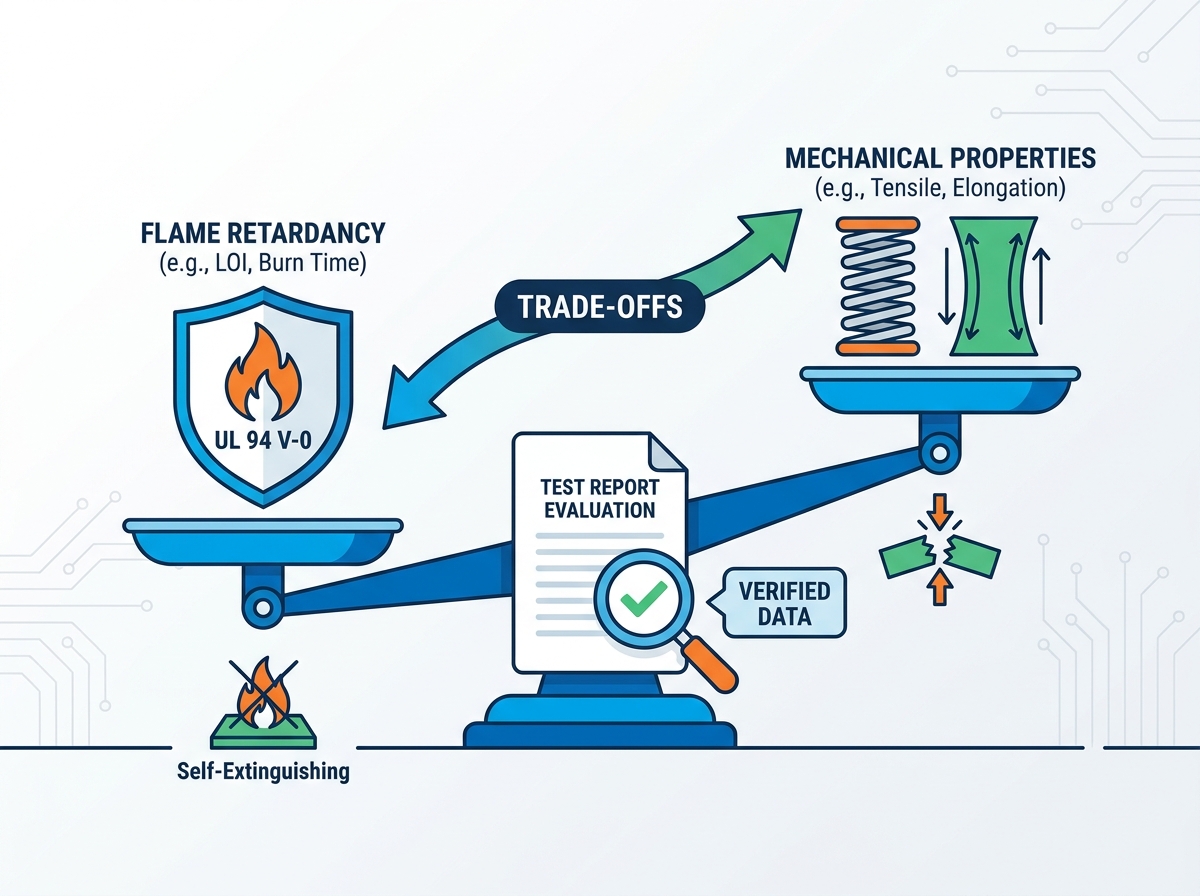
The UL 94 standard serves as the global benchmark. It evaluates plastic and rubber flammability across various industries. When evaluating UL 94 silicone rubber, you must understand specific rating classifications. The testing apparatus holds specimens vertically or horizontally, applying a standardized flame.
The V-0 rating represents the absolute gold standard. A tested specimen must extinguish in under 10 seconds. It also must produce no flaming drips. This ensures maximum safety in critical electrical enclosures and automotive battery packs.
Materials rated V-1 or V-2 extinguish in under 30 seconds. The primary distinction involves dripping behavior. V-1 materials do not produce flaming drips. Conversely, V-2 materials do produce them. These drips can ignite underlying components. You must carefully assess your assembly environment before accepting a V-2 rating.
The HB rating measures horizontal burn rates. This classification is rarely sufficient for stringent industrial applications. It only guarantees slow burning, rather than robust self-extinguishing capabilities. We advise avoiding HB ratings for high-voltage or aerospace applications.
The thickness variable remains a crucial node in any test report. You must always check the material gauge. A supplier might boast a V-0 rating at a 3.0mm thickness. If your specific application requires a 1.5mm wall, that same material might fail completely. Always match the reported test thickness directly to your actual design specifications.
UL 94 Vertical Testing Rating Criteria
Rating | Max Burn Time (Per Specimen) | Flaming Drips Permitted? | Typical Application Safety Level |
|---|---|---|---|
V-0 | < 10 seconds | No | Maximum risk mitigation |
V-1 | < 30 seconds | No | Moderate risk enclosures |
V-2 | < 30 seconds | Yes | Low risk components |
Looking past the primary UL rating reveals deeper material characteristics. Evaluating secondary metrics ensures comprehensive safety validation. These extra data points separate premium formulations from basic market alternatives.
First, examine the Limiting Oxygen Index (LOI). This percentage indicates the minimum oxygen concentration required to sustain combustion. The standard atmospheric oxygen level hovers around 21%. Therefore, materials need a much higher LOI to effectively resist burning. You should look for an LOI greater than 28% for robust resistance. Higher percentages directly correlate to superior fire-stopping capabilities. Testing standards like ASTM D2863 detail these exact measurement procedures.
Next, consider smoke density and toxicity. We use standards like ASTM E162 and E662 to measure these vital factors. Simply preventing a fire is rarely enough. In enclosed spaces like transit vehicles or aerospace cabins, toxic smoke poses a massive threat. Inhalation hazards often cause more casualties than the actual flames. Test reports must explicitly verify low smoke emission profiles. Halogen-free formulations typically perform best here.
Finally, evaluate dielectric strength post-burn. This matters significantly for advanced electrical applications. When the material eventually burns, you must know how the ash behaves. Does the remaining residue act as an insulator, or does it become conductive? Conductive carbon ash causes dangerous short circuits long after the flames extinguish. Premium formulations leave behind a non-conductive silica ash. This preserves electrical isolation and prevents secondary thermal events.
High Consistency Rubber (HCR) provides excellent structural integrity. Manufacturers heavily utilize flame retardant HCR silicone for robust extruded or molded parts. It handles complex geometries easily while maintaining strict safety profiles. The heavy consistency allows for advanced calendering and compression molding techniques.
However, compounding introduces a significant filler compromise. Base polymers require specific additives to resist fire effectively. Mixers commonly introduce aluminum trihydrate (ATH) or platinum catalysts. ATH releases water vapor endothermically when heated, cooling the material. These chemical additions inevitably alter the base polymer matrix. They disrupt the natural cross-linking process during vulcanization.
You must cross-reference flammability reports with mechanical spec sheets. Buyers often focus entirely on fire safety. They completely ignore how these fillers impact physical performance. Review these critical checkpoints carefully:
Hardness (Shore A): Additives typically increase the overall durometer rating.
Tensile Strength (MPa): Heavy filler loads can reduce structural pull resistance.
Elongation at Break (%): Flexibility usually drops significantly as flame retardancy rises.
Tear Strength (kN/m): Increased filler density can create brittle failure points.
Watch out for a glaring warning sign. Sometimes a supplier promises maximum flame retardancy alongside zero mechanical degradation. This claim is highly suspicious. Physics dictates an unavoidable trade-off. If they claim perfect flexibility alongside a V-0 rating, demand secondary validation. True experts balance these properties through precise formulation adjustments.
Procurement teams must read test reports with deep skepticism. Unreliable documentation creates immense downstream liabilities. You should actively look for specific red flags during supplier audits.
Missing laboratory accreditation stands out immediately. The testing facility must hold an active ISO/IEC 17025 certification. This proves their technical competence in calibration and testing. Relying solely on a supplier's internal in-house testing invites massive risk. Without independent third-party validation, the data remains fundamentally unverified.
Outdated certifications also signal serious trouble. Global safety standards constantly evolve. A test report from five years ago might ignore current regional safety iterations. You must ensure the documentation reflects the latest testing protocols. Annual re-verification represents an industry best practice.
Beware of generic "Yellow Cards" used entirely out of context. Suppliers often present a raw material manufacturer's UL Yellow Card as definitive proof. However, they alter this compound during their own mixing and molding processes. Adding pigments, curing agents, or extenders fundamentally changes flammability. Authentic testing must reflect the final cured state of your specific molded part.
Finally, watch for omitted test conditions. Robust reports detail exact environmental conditioning parameters. A specimen conditioned for 48 hours at 23°C behaves differently than one baked for 168 hours at 70°C. Missing variables suggest manipulated testing environments designed to force a passing grade.
Choosing the right manufacturing partner requires a structured approach. You need evidence-based selection criteria to protect your projects. Follow this framework to evaluate potential suppliers accurately and confidently.
First, request the right documentation upfront. A reliable partner will immediately provide a comprehensive documentation package. Ensure your verification checklist includes these essential items:
Certificates of Analysis (CoA) tied to specific production batches.
Third-party UL test reports matching your exact material grades.
Current and fully detailed Safety Data Sheets (SDS).
Verified RoHS and REACH compliance declarations.
Next, demand rigorous proof of batch-to-batch consistency. Formulating one perfect lab sample requires basic skill. Maintaining that precise flame-retardant mix ratio across thousands of kilograms requires manufacturing excellence. Ask for historical Quality Control (QC) data. This proves they can scale production without compromising critical safety thresholds.
Prioritize partners offering extensive prototyping and custom formulation services. Off-the-shelf materials rarely solve complex engineering challenges perfectly. Choose suppliers who embrace iterative testing. They will collaborate closely to balance your specific mechanical requirements with mandatory fire safety standards. This partnership approach guarantees long-term compliance.
Reading a technical test report goes far beyond checking a compliance box. It functions as your primary tool for strategic risk mitigation. Thorough evaluation protects your end-users and safeguards your company's long-term reputation. Every detail matters when human safety is involved.
We strongly encourage engineering teams to audit their current supplier's data sheets immediately. Apply the strict criteria outlined above. Verify the test thickness, look for third-party lab accreditations, and review inherent mechanical trade-offs. You might discover hidden vulnerabilities in your existing supply chain.
Do not leave critical material compliance to chance. Contact our engineering team today for a detailed consultation on custom formulations. We can provide compliant material samples paired with verified, transparent test reports. Let us help you secure the ideal safety profile for your next critical application.
A: The V-0 rating utilizes vertical testing and requires the material to self-extinguish in under 10 seconds without flaming drips. It offers premium fire safety. The HB rating uses horizontal testing, permitting a slow continuous burn. HB is generally inadequate for stringent industrial or high-voltage applications.
A: Yes, but options are often limited. Common flame-retardant additives, like certain metal oxides and aluminum trihydrate, naturally result in an opaque, white, or grey finish. Adding custom pigments can sometimes alter the material's flammability profile, requiring careful formulation and mandatory re-testing.
A: We highly recommend annual re-verification. Additionally, mandatory re-testing must occur anytime the supplier changes the baseline formulation, raw material source, or manufacturing process. Minor changes in curing agents or fillers can drastically impact the final flammability rating.
A: Yes, typically. High volumes of flame-retardant additives increase the material's durometer (hardness) and significantly reduce its elongation at break. This physical trade-off requires precise compounding expertise to balance mandatory fire safety with your application's structural flexibility requirements.


