

Views: 0 Author: Site Editor Publish Time: 2026-11-03 Origin: Site


Sourcing "food-grade" silicone is a high-stakes procurement decision for any global manufacturing team. Choosing incorrectly can immediately halt production lines. Failing to align material specifications with regional regulatory requirements results in customs rejections, product recalls, and severe brand damage.
Suppliers frequently use "FDA approved" or "100% LFGB" as marketing buzzwords. They often do this without providing the necessary batch-specific documentation. Furthermore, they rarely understand the precise curing processes required to pass these rigorous standards. Relying on blind trust puts your entire supply chain at risk.
We will equip product managers and procurement teams with a skeptical, evidence-based framework. You will learn how to evaluate suppliers properly and choose the correct compliance standard for your target market. We will also show you how to audit documentation effectively to guarantee consumer safety.
Standard Strictness: LFGB (Europe) is a significantly more rigorous testing standard than FDA (US), particularly regarding Volatile Organic Compounds (VOCs) and extraction limits.
Material Implications: Passing LFGB typically requires higher-cost food grade platinum silicone rubber, whereas standard FDA requirements can often be met with cheaper peroxide-cured silicone.
Global Scalability: LFGB-compliant silicone is generally accepted worldwide (including the US), while FDA-compliant silicone is often rejected in European markets.
Verification is Mandatory: Visual inspections (like the "pinch test") are consumer myths; B2B buyers must rigorously audit third-party silicone rubber compliance test reports (SGS, TÜV, Intertek) to verify claims.
Understanding the exact legal jurisdiction of your target market is the first step in silicone procurement. Different regions enforce vastly different thresholds for chemical migration. You cannot treat food-contact materials as a universal standard.
The US Food and Drug Administration (FDA) governs materials in contact with food. This specific regulation (CFR Title 21.177.2600) applies to the United States, Canada, and parts of Asia and South America. It serves as a baseline safety requirement. The testing focuses primarily on extraction limits. Laboratories use distilled water and n-hexane as liquid simulants. They measure how much of the silicone material leaches into these liquids over a set period. It is a reliable standard but leaves gaps regarding extreme temperatures and aggressive acidic foods.
The Lebensmittel-, Bedarfsgegenstände- und Futtermittelgesetzbuch (LFGB) is the German benchmark. It acts as the de facto gold standard for the broader European Union. It perfectly complements the overarching EU standard EC 1935/2004. This standard mandates extensive testing for heavy metals, peroxides, and organic volatiles. Testers subject the material to extreme temperature conditions. They ensure the silicone does not alter the smell or taste of the food.
Procurement teams make a common mistake by assuming global parity between standards. Sourcing FDA silicone for an EU-targeted product will likely result in compliance failure at the border. Customs agencies in Europe routinely test inbound shipments. If your product fails LFGB testing, authorities will seize or destroy the inventory. You must align your material choice directly with your target geographic market.
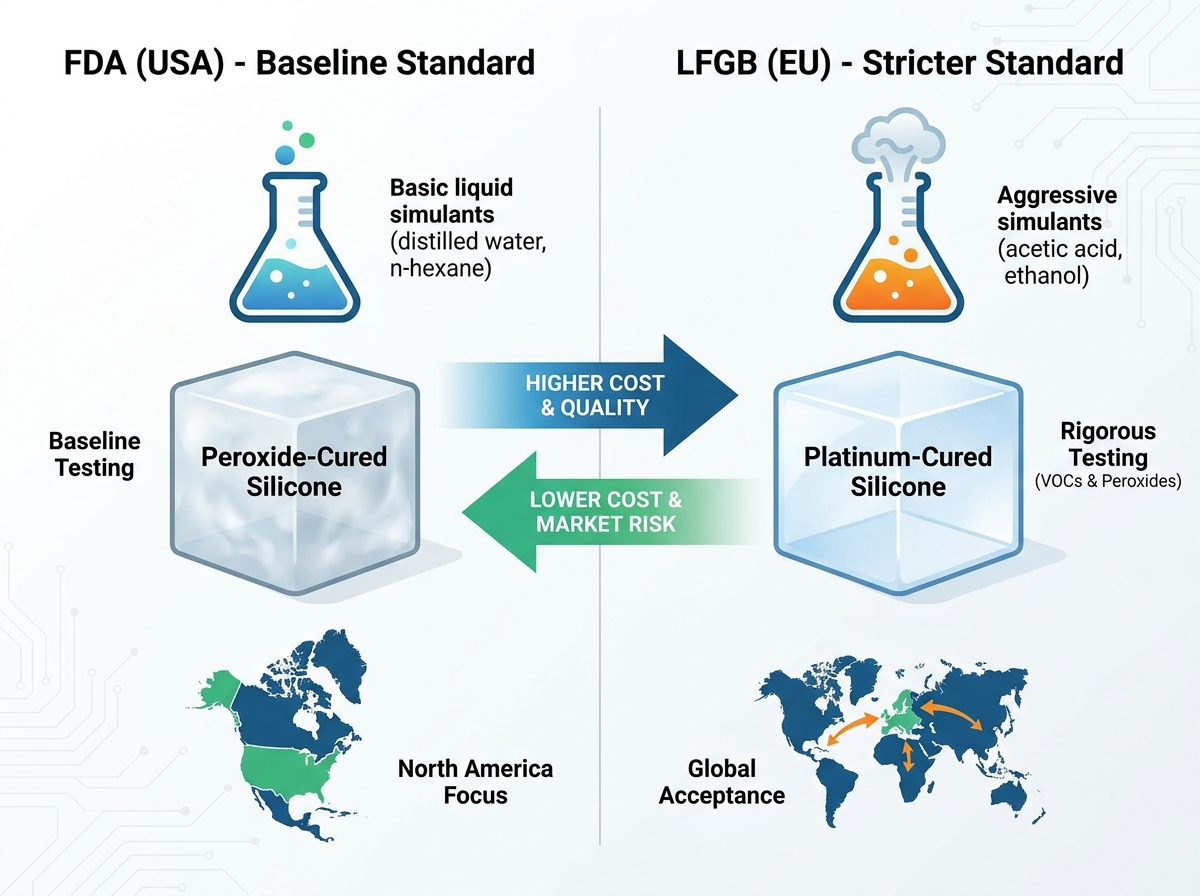
When comparing FDA vs LFGB silicone rubber, buyers must look past the marketing labels. You must understand the specific chemical and financial differences. These differences dictate product performance, safety, and ultimately, your profit margins.
The gap between these two standards becomes obvious in the laboratory. The stringency of the simulants used completely changes the required material composition.
Extraction Tests: The FDA uses baseline liquid simulants. It primarily tests with distilled water. LFGB uses much more aggressive simulants. Testers use 3% acetic acid and 10% ethanol. This mimics diverse food types, like citrus or alcohol, over longer storage periods.
Volatile Organic Compounds (VOCs): LFGB strictly limits VOCs. The threshold is typically below 0.5%. High VOCs cause off-gassing and can taint food flavors. FDA standards are far more lenient regarding this off-gassing.
Peroxide Value: LFGB explicitly tests for hazardous peroxide residues. If the lab detects these chemicals, the material fails immediately. The FDA does not have a direct equivalent test for this in its baseline standard.
Table: Regulatory Standards Comparison Chart
Testing Parameter | FDA (US) Requirements | LFGB (EU) Requirements |
|---|---|---|
Simulants Used | Distilled water, n-hexane | 3% acetic acid, 10% ethanol, oils |
VOC Limits | Generally lenient | Strictly < 0.5% |
Peroxide Testing | Not explicitly required in baseline | Mandatory testing; must be negative |
Heavy Metals | Basic thresholds | Extensive screening required |
Superior testing parameters directly impact your unit economics. LFGB-compliant raw materials and their associated testing protocols carry a 20% to 40% premium. This is noticeably higher than standard FDA-compliant equivalents. Buyers must carefully weigh this premium against target market retail pricing. If you are selling a low-cost kitchen gadget in the US, LFGB might erode your margins unnecessarily. If you are selling premium baby products globally, the LFGB premium is an unavoidable investment.
The secret to passing compliance tests lies in the manufacturing chemistry. You cannot simply take standard industrial silicone and declare it food safe. The curing agent used during production dictates the final purity.
Many factories prefer peroxide-cured silicone because it offers a lower production cost. This method uses peroxide catalysts to bond the silicone polymers. It often passes baseline FDA requirements without issue. However, it inevitably contains chemical residues. These residues will trigger an instant failure in European LFGB testing.
There are practical drawbacks to this material. Peroxide-cured silicone is prone to leaving a faint chemical odor. Over time, it may also develop a white powdery residue on the surface. We advise avoiding this curing method for high-end consumer goods, even if they only target the US market.
Choosing the right catalyst eliminates residual toxicity. Platinum curing is the mandatory requirement for genuine LFGB compliance. Food grade platinum silicone rubber uses a precious metal platinum catalyst. This sophisticated process results in a significantly purer, completely odorless product. It boasts higher temperature resistance and generates zero toxic byproducts during manufacturing.
Evaluation lens: You must remain vigilant when analyzing quotes. If a supplier claims full LFGB compliance but quotes standard peroxide-cured prices, the claim is highly suspect. Platinum is an expensive catalyst. The raw material cost simply cannot match standard industrial grades. Protect your business by questioning aggressive undercutting.
Trusting a supplier's word is a fast track to a product recall. Procurement teams must develop strict auditing habits. You need to know exactly what to look for when reviewing safety documentation.
Consumers frequently share a popular myth online. They believe that twisting or pinching silicone proves its safety. If the pinched area turns white, they claim it is fake or toxic. This is scientifically inaccurate. The white color only indicates filler density. Factories use silica as a filler to strengthen the material. Silica is completely safe and food-grade, but it turns white under stress. The pinch test proves nothing about chemical safety or curing agents. B2B buyers must abandon this urban legend and rely on laboratory science.
When you evaluate a new factory, you must demand actual proof. Here is what procurement teams must look for in third-party lab reports:
Issuing Authority: The document must come from a verifiable, internationally recognized lab. Acceptable organizations include SGS, TÜV SÜD, Intertek, or Eurofins. Do not accept in-house factory reports.
Date of Issue: Reports older than one to two years are obsolete. Material formulations change frequently. A 2019 report offers no protection for a 2024 production run.
Exact Material Match: The silicone rubber compliance test reports must list the specific raw material grade. They must also specify the exact color being purchased. A generic, overarching material class report is useless for customs clearance.
Actual Test Results vs. Claims: Read the data tables carefully. Verify that the report explicitly shows a "PASS" for the specific standard required (e.g., LFGB Section 30 & 31). Do not accept a report that only tests physical properties like tensile strength.
Choosing between standards requires strategic alignment with your business goals. You should not over-engineer a product if the market does not demand it. Conversely, you cannot afford to cut corners on premium goods.
You should specify standard FDA compliance when:
Your primary market is exclusively North America.
The product has brief, low-temperature food contact (e.g., a simple spatula handle).
Unit economics are highly constrained, and the retail price point is very low.
You must invest in LFGB compliance when:
You are launching directly in the EU or plan to scale globally in the future.
The product is subjected to high heat over long periods. Examples include baking mats, baby pacifiers, and sous-vide cooking bags.
Your brand positioning heavily relies on premium safety, health, and purity claims.
Actionable procurement requires hands-on verification. First, request sample batches from your shortlisted suppliers. Second, demand the raw material safety data sheets (MSDS) before signing any purchase orders. Finally, commission independent verification testing for your first production run before scaling up to mass manufacturing. It is an upfront cost that prevents catastrophic losses later.
The choice between FDA and LFGB silicone is not just a regulatory checkbox. It fundamentally dictates your material selection, dictates your production costs, and shapes your global market viability. Understanding the differences protects your supply chain from sudden disruptions.
Our final advice is to trust, but verify. Do not accept the phrase "food-grade" as a blanket guarantee. Base your procurement decisions solely on current, batch-specific test reports. You must also maintain a clear understanding of the curing process used in your goods.
We encourage buyers to take immediate action. Contact your prospective sales and engineering teams today. Request audited LFGB or FDA product samples. Demand to review their current, third-party compliance documentation before moving forward with any new designs.
A: No. FDA testing parameters are less stringent regarding VOCs and specific extractables. FDA-compliant silicone will frequently fail EU/LFGB customs audits. You must specifically request LFGB-compliant materials for European markets.
A: Yes. While platinum curing is usually required for LFGB, the addition of cheap colorants, low-quality fillers, or cross-contamination in the manufacturing facility can still cause the final product to fail compliance testing. Cleanroom practices remain essential.
A: No. Pigments alter the chemical composition of the material. Compliance test reports should technically be provided for the specific colorway or the base material plus the specific masterbatch being used. Adding untested dyes invalidates the original safety report.


